
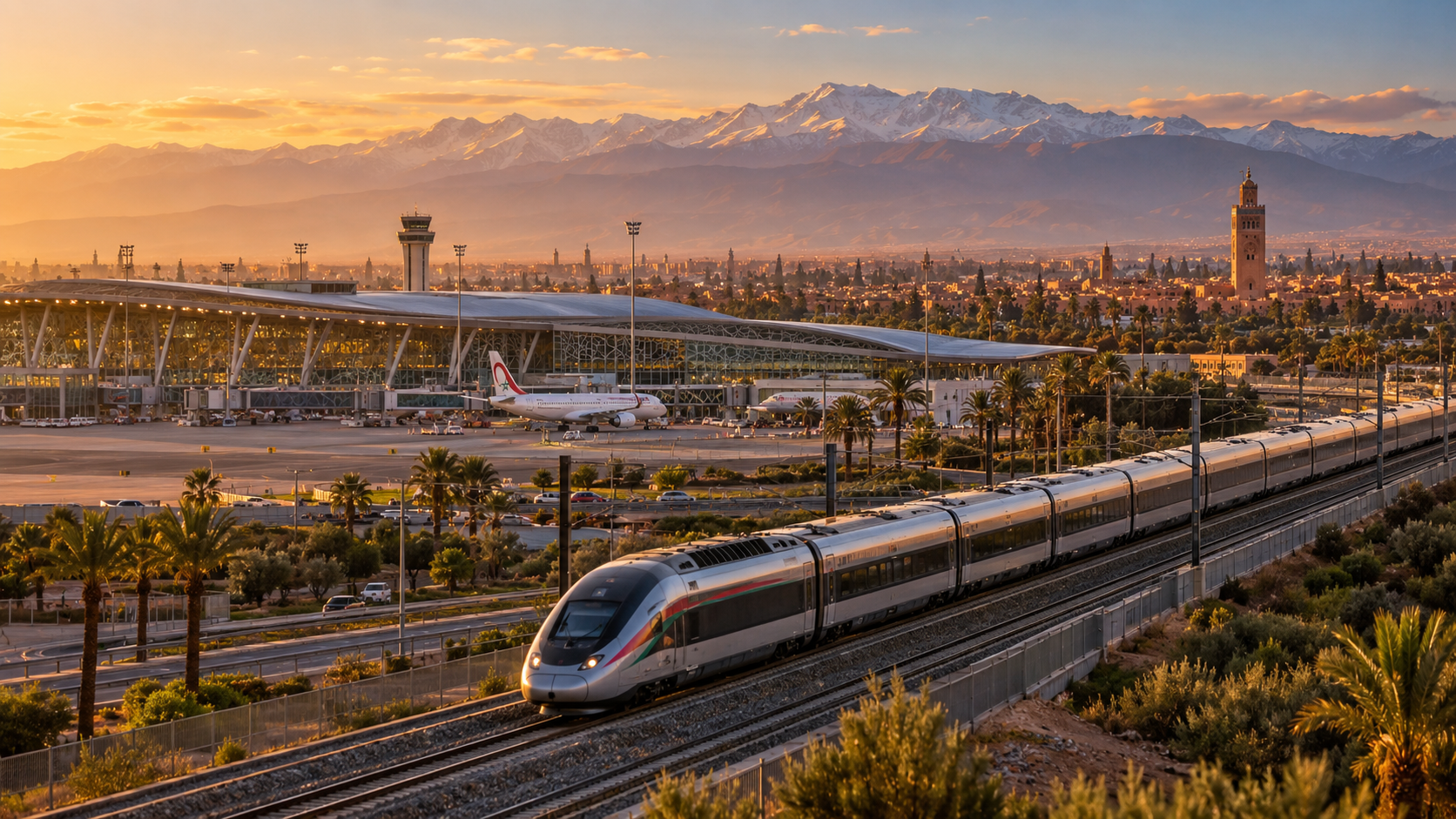
Land at Casablanca’s Mohammed V airport today and the onward journey has hardly changed in a decade. Passport control, the shuttle train into the city, a change of platform and, if Marrakech is where you are heading, the best part of an afternoon on the rails. By 2030 the plan is different. You step off the plane, walk down to a high-speed platform beneath the terminal, and about fifty-five minutes later you are in Marrakech.
That one journey explains Morocco 2030 better than any stadium render. The World Cup, which Morocco co-hosts with Spain and Portugal, has given the country a date it cannot move. What is being built against that date is far larger: a new terminal and runway in Casablanca, bigger airports in Marrakech, Agadir, Tangier and Fès, 430 kilometres of new high-speed railway, and a tourism industry being asked to grow from 19.8 million visitors in 2025 to 26 million by 2030.
Some of it is financed and under construction. Some of it is still a target. The difference matters if you are planning a trip, so this guide keeps the two apart.
The line to 2030
Tangier to Marrakech at up to 320 km/h
- TangierAl Boraq high-speed terminus since 2018. Target with the full network: Tangier–Marrakech in about 2 h 40
- KenitraWhere the new high-speed line to Marrakech begins
- RabatNew line serves Rabat–Salé airport. Tangier–Rabat in about 1 h
- CasablancaCasablanca–Marrakech in about 1 h 15
- Mohammed V AirportNew high-speed station under the airport. Rabat in about 35 min
- MarrakechAbout 55 min from the airport station
Journey times are ONCF targets for the completed network, not today’s timetable.
Morocco 2030 at a glance
The headline numbers, as announced by the Moroccan government, the airports authority ONDA, the railway operator ONCF and the tourism ministry. Read them carefully: several are capacities and targets for 2030, not what is running today.
M26 million
visitors targeted by 2030
M80 million
airport passengers a year, 2030 capacity target
km430 kilometres
of new high-speed line, Kenitra to Marrakech
km/h320 kilometres per hour
planned top operating speed
| Project | Figure |
|---|---|
| Airport investment programme 2025–2030 | MAD 38 billionSigned |
| African Development Bank airport loan | €270 millionSigned Sept 2026 |
| Casablanca Mohammed V component | Around MAD 25 billion: new terminal and runway |
| National airport capacity | 80 million passengers a yearTarget |
| Marrakech / Agadir / Tangier / Fès | 14M / 5M / 3.6M / 3M passengersTarget |
| Kenitra–Marrakech high-speed line | About 430 km, MAD 53 billionUnder construction |
| Wider ONCF rail programme | MAD 96 billion, including 168 new trains |
| Tourism in 2025 | 19.8 million visitors, MAD 138 billion receipts |
| Tourism in 2030 | 26 million visitorsTarget |
Status as of October 2026. Figures from official Moroccan government, ONDA, ONCF and tourism ministry announcements.
Why Morocco is moving so fast
The World Cup is the obvious explanation, and it is only half of one.
Morocco, Spain and Portugal were confirmed as the principal hosts of the 2030 tournament, with three centenary matches played in Uruguay, Argentina and Paraguay. That fixed the calendar for stadiums, transport and hotels. But the tourism curve was already climbing before the football arrived.

In 2019 Morocco received roughly 13 million visitors. In 2024 it was 17.4 million. In 2025 it was 19.8 million, up 14 per cent in a single year, with tourism receipts of MAD 138 billion, and the country moved ahead of Egypt as Africa’s most visited destination.
Tourist arrivals
The road to 26 million
A football tournament lasts a month. What Morocco is really trying to build is a gateway between Europe, Africa and the Atlantic: a country people do not simply fly into, but move through.
The airports: built for 80 million passengers
In July 2025 the government and ONDA signed a MAD 38 billion investment programme for 2025–2030. The aim is to take national airport capacity to around 80 million passengers a year, roughly double what the network handles now.
For a while that read like a press-release number. It reads differently since the end of September 2026, when Morocco and the African Development Bank signed a €270 million loan in Casablanca for the airport expansion and modernisation programme, known by its French acronym PEMIA. Money on paper has become money in a contract.
The loan targets four hubs. By 2030 the programme is designed to lift capacity to 14 million passengers in Marrakech, 5 million in Agadir, 3.6 million in Tangier and 3 million in Fès.
Marrakech: 14 million passengers
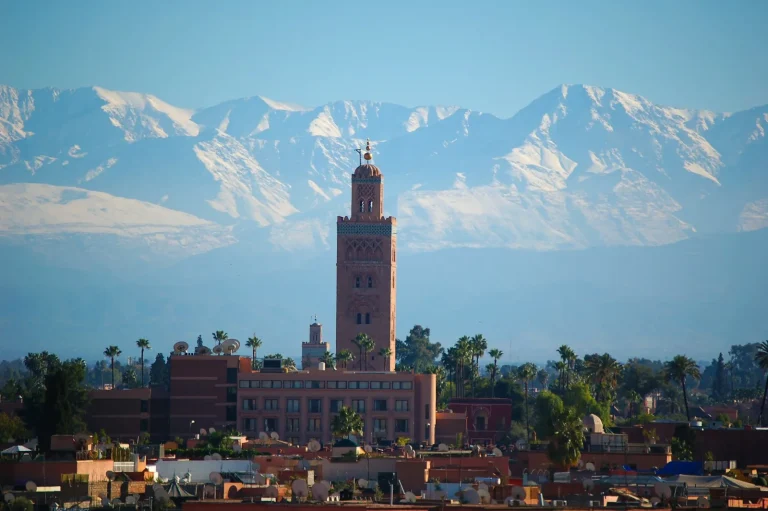
Marrakech matters most to leisure travellers, and the figure says a great deal about where the city is going. It is no longer sold only as a medina break of Jemaa el-Fna, souks and riads. It has become the base camp for the High Atlas, the desert, golf, food, festivals and the long multi-stop trips that used to start in Casablanca.
There is a less glamorous side. Until the works are finished, expect scaffolding, temporary layouts and the occasional long walk to a gate that did not exist on your last visit. Leave more time than you think you need.
Casablanca: the airport becomes a station
Casablanca is where the plan is boldest. The programme includes a new hub terminal and a new runway at Mohammed V, with around MAD 25 billion earmarked for the Casablanca component alone.
The real change, though, is underground. The new high-speed line runs into the airport itself, through a covered trench beneath the site, with its own station. Planes, high-speed trains, regional services and the motorway meet in one place.
The high-speed line to Marrakech
Morocco already runs Africa’s first high-speed railway. Al Boraq has linked Tangier and Kenitra at high speed since 2018, continuing to Rabat and Casablanca on the conventional line.
The next stage is the one that changes tourism. On 24 April 2025 King Mohammed VI launched works on a new line from Kenitra to Marrakech: about 430 kilometres, designed for up to 320 km/h, serving Rabat–Salé airport and Casablanca Mohammed V on the way. ONCF puts the infrastructure at MAD 53 billion, inside a wider MAD 96 billion rail programme that also buys 168 new trains.
It is no longer a drawing. By May 2026 the transport minister put progress at around 30 per cent. Land acquisition is complete, fifteen viaducts are under construction, and the ballast, sleepers and rails are already stockpiled along the route.
These are projections for the finished network, not the times you will see on a ticket today. Plan a 2026 or 2027 trip on the current timetable.
Beyond Marrakech, studies for a second phase towards Agadir have been completed, with an estimated cost of MAD 55 billion. That one is still looking for its financing.
How the classic Morocco itinerary changes
For decades the first trip to Morocco has followed one of two scripts.
or
Distance wrote both of them. Long transfers, domestic flights, a driver for the day. High-speed rail rewrites the arithmetic.
Tangier stops being a separate holiday and becomes a realistic add-on to Marrakech. Rabat, so often skipped on the way between Casablanca and Fès, becomes an easy stop. A seven-day trip built around the train could look nothing like the one in most guidebooks, ours included, and we will rewrite our Tangier and Fès guides as the line opens.
Hotels and riads under mystery inspection
The quietest change may be the one travellers feel most.
Since May 2026, inspectors posing as ordinary guests have been checking 2,500 classified establishments across the kingdom. The system comes from law 80-14 and covers hotels of three stars and above, hotel clubs, tourist residences, guesthouses, riads and kasbahs.
They do not just count rooms and pools. They book, check in, eat, call room service, check out, and score the whole experience against grids of 235 to 387 criteria depending on the category, drawn up with the UN’s tourism agency and published in the official bulletin. Places that fall short are given time to put things right before any final decision.
Infrastructure brings people into a country. Service decides whether they come back.
Morocco has some of the finest riads anywhere, and some very uneven ones. If you are choosing now, our guide to picking the right riad in Morocco explains what to look for.
What Morocco 2030 means for travellers
Getting around gets easier
Bigger airports plus fast trains make multi-city trips far more practical, and a car far less necessary.
Marrakech goes more international
More capacity and more routes will reinforce Marrakech as Morocco’s main leisure gateway.
Casablanca stops being just an arrival point
An air–rail hub makes the city strategic even for travellers who never sleep there.
Secondary destinations open up
Better national transport spreads visitors towards places most international travellers still overlook.
Construction is part of the deal
Projects on this scale are not invisible. Before 2030 expect road works, railway sites, changing airports and big urban projects. That is not a reason to stay away, only a reason to plan with current information.
Confirmed vs planned: the difference that matters
Headlines about Morocco 2030 tend to blend finished projects, financed projects, targets and ideas into one bright paragraph. They are not the same thing.
Confirmed or underway
- Morocco, Spain and Portugal are the principal hosts of the 2030 FIFA World Cup.
- The government–ONDA airport programme for 2025–2030 totals MAD 38 billion.
- The €270 million African Development Bank loan was signed in September 2026.
- The Kenitra–Marrakech high-speed line is under construction, around 30 per cent complete by May 2026.
- Morocco received 19.8 million tourists in 2025.
- Mystery inspections of 2,500 hotels and riads began in May 2026.
Targets for 2030
- An airport system handling 80 million passengers a year.
- Marrakech airport capacity of 14 million passengers.
- All high-speed journey times above, which depend on the new line being completed and running.
- 26 million tourists a year: an objective, not a guarantee.
- The Marrakech–Agadir extension, studied but not yet financed.
We keep that line clear in all our Morocco 2030 coverage.
Is Morocco changing too much?
Airports and fast trains make travel easier. They have never been the reason anyone falls for Morocco.
That comes from medinas whose streets were never meant for cars, family-run riads, souks, small cafés, mountain villages, Atlantic fishing ports, Amazigh culture, the desert, and a pace of life that no ministry can build. The real test before 2030 is not speed. It is whether Morocco can modernise without turning every destination into the same destination.
Want the better airport. Then want the Morocco outside it to stay Morocco.
That balance will be one of the stories worth watching over the next four years.
Go now or wait for 2030?
Go now. There will always be another terminal, another hotel, another line on the horizon.
Morocco is already one of the most rewarding countries in the world to travel through. The next few years add something rarer: the chance to watch a country change shape. Visit Marrakech now and again in 2030 and you may not recognise the journey, even if the medina is exactly where you left it.
The final will be played, the stadiums will empty, and the airports, the railway and the new connections will still be there. That is the real story of Morocco 2030. And it is happening now.
Frequently asked questions
Is Morocco hosting the 2030 World Cup?
Yes. Morocco, Spain and Portugal are the principal hosts of the FIFA World Cup 2030. Three centenary matches will also be played in Uruguay, Argentina and Paraguay.
Is there a high-speed train from Casablanca to Marrakech yet?
Not yet. Al Boraq runs at high speed between Tangier and Kenitra and continues to Rabat and Casablanca. The new Kenitra–Marrakech line is under construction and was around 30 per cent complete in May 2026.
How long will Casablanca to Marrakech take by train?
ONCF targets about 1 hour 15 minutes between Casablanca and Marrakech, and about 55 minutes from the Mohammed V airport station to Marrakech, once the new line is running.
How many tourists does Morocco want by 2030?
The official target is 26 million visitors a year by 2030, up from 19.8 million in 2025.
How big will Marrakech airport become?
The airport programme targets a capacity of around 14 million passengers a year at Marrakech by 2030.
Should I wait until 2030 to visit Morocco?
No. Morocco is already an easy and rewarding country to visit. Expect some construction at airports and on the roads, and plan with today’s timetables rather than the 2030 projections.
Continue planning
start with the 9 most beautiful places in Morocco, add a night in the dunes with our Sahara guide to Merzouga and Erg Chebbi, and check the entry rules in our Morocco visa guide before you book.
Updated October 2026. We will keep revising this guide as the airports, the railway and the tourism projects move from plan to construction to opening day.

Leave a comment