

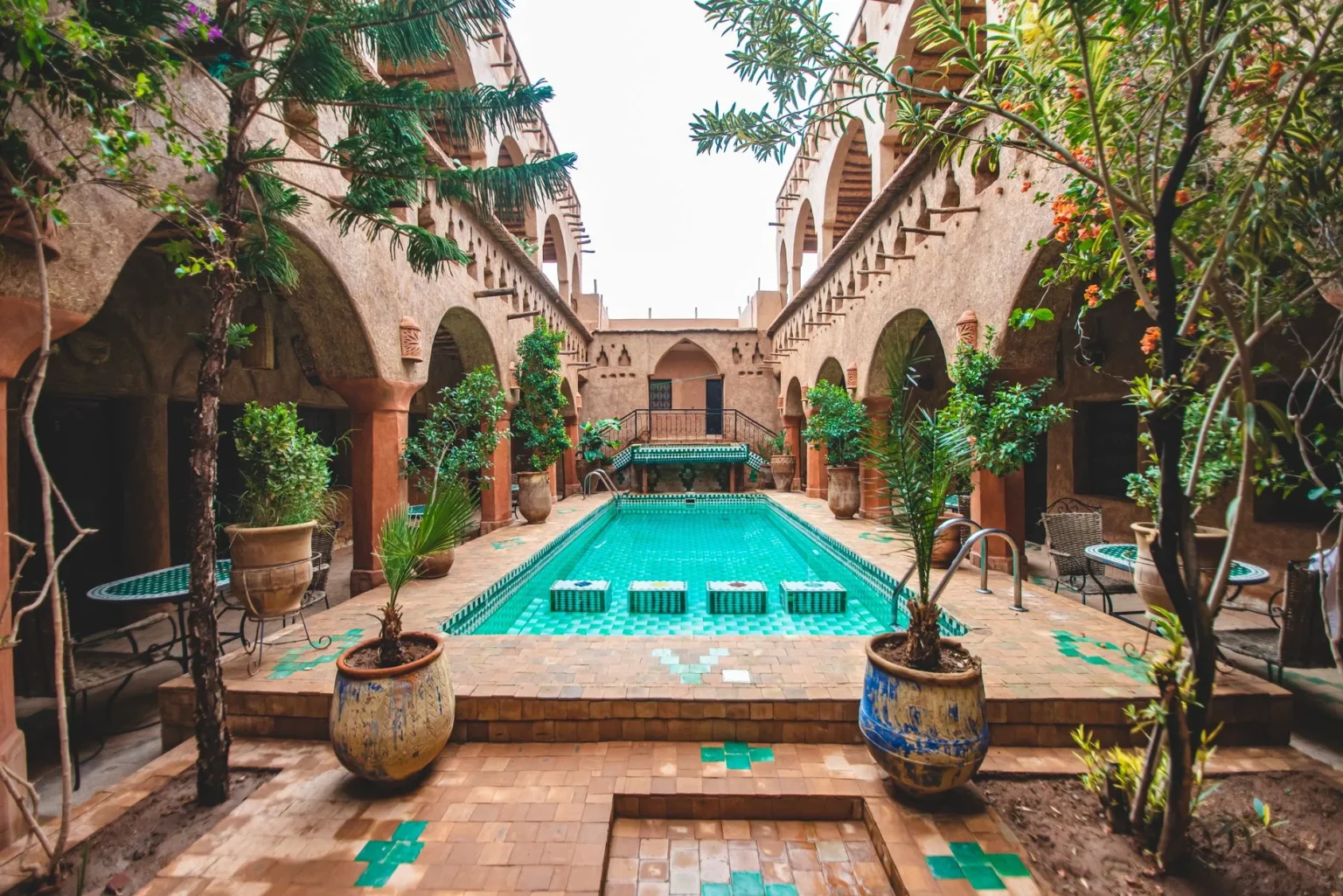

There is a specific kind of disappointment that comes from booking a riad badly. The photographs showed a courtyard with orange trees and a fountain. You arrive to find that the courtyard is indeed beautiful, and that your room is on the ground floor beside it, has no window to the outside, holds the temperature of a cellar in January, and carries every word spoken by the German couple on the terrace three floors up as if they were sitting on your bed.
Nothing was misrepresented. You simply booked a riad as though it were a hotel, and it is not one.
What a riad actually is
The word riad means garden. Strictly, a riad is a traditional urban house built inward around a planted central courtyard, open to the sky, with rooms arranged on the surrounding floors and almost no windows facing the street. A dar is the same arrangement without the garden — a smaller courtyard, often paved or tiled. In practice the tourist trade uses riad for both, and increasingly for anything in a medina with a courtyard and a licence.
The architecture is not decorative. It is a response to climate and to a social order that kept family life private. Thick walls and a shaded courtyard produce a building that is genuinely cool in August. The same thick walls, with no insulation and a hole in the roof, produce a building that is genuinely cold in January. This single fact explains most riad complaints.
The materials are worth knowing by name, because they tell you what you are paying for. Zellij is hand-cut glazed tile mosaic, laid piece by piece — the geometric work on floors and lower walls. Tadelakt is polished lime plaster, waterproof, used in bathrooms and hammams, with a soft sheen and no grout lines. Bejmat are the small terracotta floor bricks laid in herringbone. Carved cedar appears on doors, ceilings and the galleries above the courtyard. A restored riad using all four is expensive to build and expensive to maintain, and the room rate reflects it.
The five things to check before you book
1. Which room, not which riad
This is the single most important point. Rooms within the same riad vary enormously, and the listing photographs usually show the best one.
Ground-floor rooms open directly onto the courtyard. They are the coldest, the darkest, and the least private — anyone crossing the courtyard passes your door. They are also usually the cheapest, which is why they are what gets booked.
First-floor rooms are the compromise most people want. Second floor and above get the light, the air and, in the better houses, a private or semi-private terrace. In a four-storey riad with no lift, they also get the stairs — and riad stairs are steep, stone, and often lit only by the courtyard.
Write to the property before booking and ask for photographs of the specific room you are being allocated, plus its floor. A good riad answers this within a day. One that does not is telling you something.
2. Heating, by name
Between November and March this decides whether your stay is pleasant. “Heating available” can mean underfloor heating and a working fireplace, or it can mean a small electric convector wheeled in at nine in the evening.
Ask what type. Ask whether it runs all night. Ask the same about air conditioning if you are coming in July, when Marrakech routinely passes 40°C and the courtyard stops helping some time in the afternoon.
3. How you get to the door
Vehicles cannot enter most medinas. Your taxi stops at a gate, and from there it is a walk through lanes that do not appear on standard mapping, carrying luggage, usually after a flight.
Every competent riad will meet you at the nearest vehicle access point if you tell them your arrival time, and most will send someone with a cart. Arrange this in advance and in writing. The alternative — arriving at a medina gate at eleven at night with a suitcase and a phone that cannot find the address — is a genuinely unpleasant experience and an entirely avoidable one.
Also ask the distance. “Five minutes from Jemaa el-Fnaa” and “five minutes from the nearest point a car can reach” are different numbers, and only the second one matters at midnight.
4. Sound
A courtyard open to the sky is an acoustic chamber. Conversation on the terrace carries down. Breakfast service carries up. A riad with eight rooms and a full house is a lively building at seven in the morning.
Added to that, you are inside a medina. There will be a mosque, and the first call to prayer comes well before dawn. Most visitors find they stop noticing it after two nights. Some do not. If you sleep badly, take the highest room available and bring earplugs.
5. Whether dinner is served
Many riads cook dinner on request, usually needing a few hours’ notice. This is frequently the best meal you will eat in the city — home cooking rather than restaurant cooking, at a price well below the restaurants trading on rooftop views.
It is also the answer to your first night, when you have arrived tired and do not want to go back out into the medina to find food.
How the cities differ
Marrakech
The largest concentration of riads in Morocco, and the widest quality range — from six-room family houses to heavily restored properties with staff, spas and plunge pools.
Location within the medina matters more than in any other Moroccan city. The area around Jemaa el-Fnaa is convenient and loud. The Mouassine and Dar el Bacha quarters to the north are quieter, better for the souks, and full of the best-restored houses. The Kasbah, in the south near the Saadian Tombs and the Badi Palace, is calmer still and slightly removed from the shopping. Riad Laarous, further north, is where you find space for less money.
On plunge pools: they are small, they are usually unheated, and in a shaded courtyard between October and April they are for looking at.
Fès
Fès el-Bali is older, larger and considerably harder to navigate than the Marrakech medina, and the merchant houses there are correspondingly grander — higher courtyards, more elaborate plasterwork, a sense of having been built for people with serious money in the fourteenth century, because they were.
The medina is also built on a slope, the lanes are narrower, and vehicle access points are further from most doors. Confirm the arrival arrangement here in particular.
The trade-off is worth making. Fès riads are generally better value than their Marrakech equivalents and the buildings themselves are often more interesting.
Essaouira
Smaller houses, frequently called dars, built inside eighteenth-century Portuguese-influenced ramparts. The medina is compact, laid out on a grid, and — unusually — easy to walk. Several properties face the Atlantic.
Essaouira is windy essentially all year. This is why it is a kitesurfing town and why its summers are bearable. It also means the sea-facing rooms are the atmospheric ones and the courtyard-facing ones are the warm ones.
Rabat and the north
Rabat’s riads cluster in the Kasbah of the Oudayas, above the river mouth — a small, whitewashed-and-blue quarter with a fraction of the tourist pressure of Marrakech. Numbers are limited but standards are high.
In Chefchaouen and Tetouan the houses are simpler, mountain buildings rather than merchant palaces, and priced accordingly. Expect character and a fireplace rather than zellij and a spa.
What “best” actually costs
Rates move with season and demand, so treat these as bands rather than prices.
At the bottom, a clean, family-run riad with a handful of rooms, breakfast on the terrace and no frills. At the middle, a properly restored house with a hammam, a pool of some kind, staff who will organise your transport, and dinner on request. At the top, a small number of properties where the restoration itself is the point — museum-grade craftsmanship, a room count in single figures, and a service ratio to match.
The sharpest jump in quality is from the bottom band to the middle. The jump from middle to top buys you craftsmanship and privacy, not comfort — you already had that.
High season in Marrakech runs spring and autumn, plus Christmas and New Year, when rates can double and minimum stays appear. August is hot enough that prices soften.
Three things that go wrong
The riad that is not in the medina. Some properties outside the walls use the word for marketing. They may be perfectly good hotels. They are not riads, and you will be taking a taxi to and from everything.
The wide-angle lens. Courtyards photograph larger than they are. So do rooms. If every photograph is a corner shot, assume the space is small.
Booking the whole house for a group. Excellent idea, frequently mishandled. Confirm in writing that exclusive use means exclusive use, including the terrace and the pool, and establish what is included in the way of meals before you arrive rather than after.
The short version
Pick the floor, not just the house. Ask what the heating actually is. Tell them when you are arriving and let them meet you. Take the room with the terrace if you can afford it and the room above the ground floor if you cannot.
Do that and a riad is the best accommodation in North Africa — a building designed around silence, shade and water, in the middle of a city that has neither. Do it carelessly and you have paid a premium for a cold room with a view of a wall.
