


Morocco has four imperial cities — Marrakech, Fès, Meknès and Rabat — and each has been a seat of a ruling dynasty at some point in the last thousand years. That history left behind palaces, and a good number of them are now hotels.
But “luxury” in Morocco covers at least three different products that are often priced similarly and are not remotely the same experience. Knowing which one you are buying matters more than any ranking.
The three kinds of Moroccan luxury
The palace hotel
Large, formal, usually with grounds, a full spa, multiple restaurants and a hundred rooms or more. These are the properties with international recognition, and they operate to international service standards.
What you get: consistency, space, a proper pool, a concierge who can fix anything, air conditioning that works, and the ability to arrive at midnight without arranging anything in advance.
What you do not get: intimacy, or much sense of being in a medina. Most sit outside the old walls.
The restored riad
Six to fifteen rooms in a converted courtyard house inside the medina. The best of these are extraordinary — craftsmanship you cannot buy new, a level of attention that a large hotel cannot match, and a location that puts you inside the city rather than beside it.
The trade-offs are structural, not incidental: no vehicle access to the door, stairs instead of lifts, courtyard acoustics, and heating that depends entirely on what the owner installed. Our guide to choosing a riad covers what to check before booking.
The resort outside the city
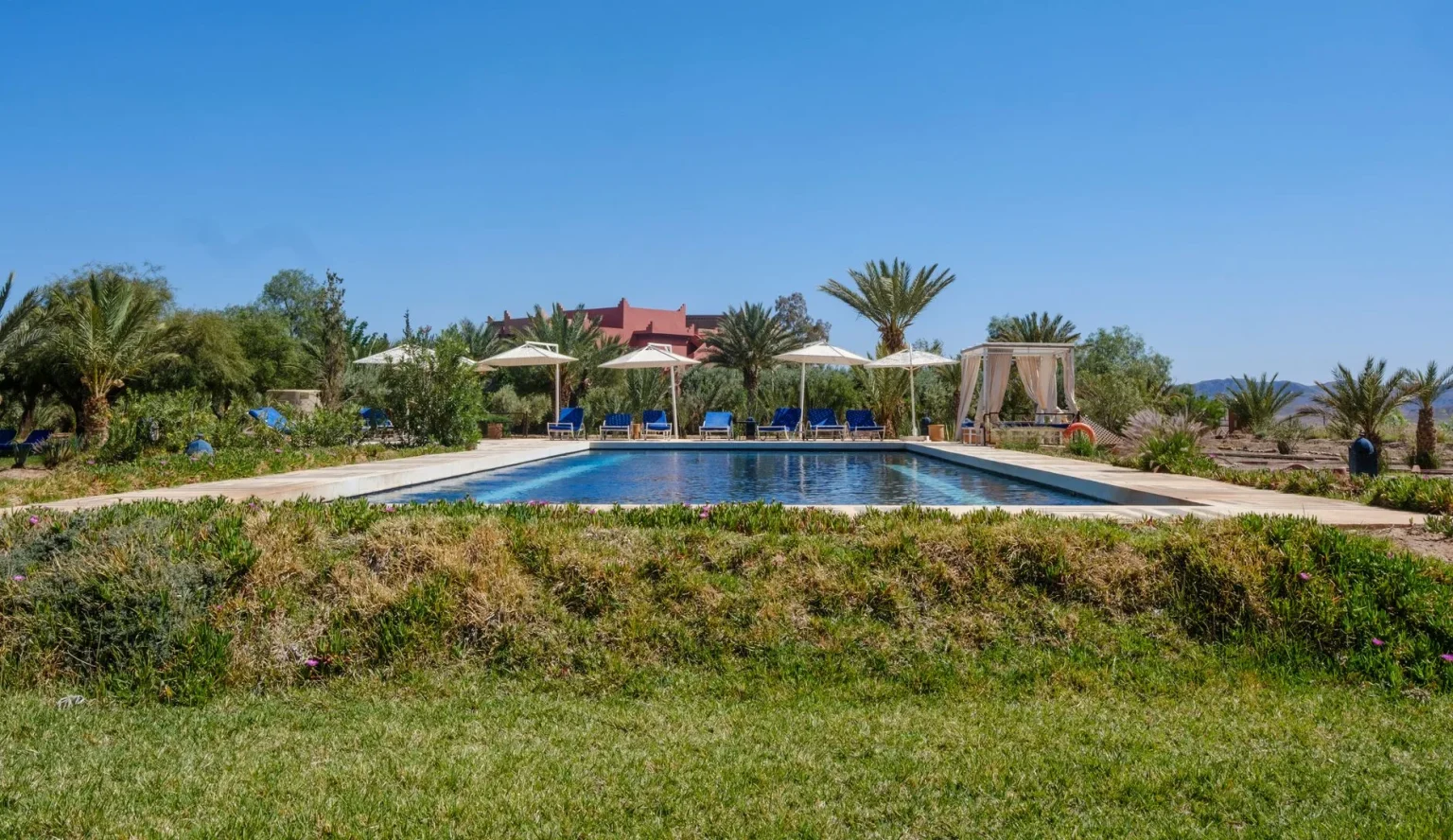
Increasingly common around Marrakech in particular — golf, gardens, large pools, and a fifteen-to-thirty-minute drive to anything historic. Excellent for a week of doing very little. A poor base if you came to see the country.
Marrakech
The deepest luxury market in Morocco by a considerable distance, and the only one with genuine competition at the top.
La Mamounia is the landmark. It opened in 1923 on gardens that were a royal wedding gift in the eighteenth century, and it has been through several restorations since. It is the hotel Moroccans name when you ask, and the gardens alone justify a visit — you can take tea there without staying.
Royal Mansour was commissioned by King Mohammed VI and opened in 2010. It is built as a miniature medina: individual riads rather than rooms, each with its own courtyard, roof terrace and plunge pool, connected by a network of underground service tunnels so that staff are effectively invisible. It is the most expensive hotel in the country and the craftsmanship is the reason — it was built by hundreds of Moroccan artisans over several years.
Below that tier, the Hivernage district holds most of the large international properties, while the best small luxury is inside the medina in the Kasbah and Mouassine quarters.
Where to actually stay depends on the trip. First visit, three or four nights, wanting to see the city: a good riad in the medina. A week with children or a need to decompress: something with a real pool outside the walls.
Fès
The most interesting luxury in Morocco, and the least expensive at equivalent quality.
Fès el-Bali holds merchant houses built in the fourteenth to eighteenth centuries for families with serious money, and the restorations of the last two decades have turned a number of them into small hotels. The plasterwork, cedar and zellij in these buildings is frequently better than anything in Marrakech, because the houses were grander to begin with.
The constraint is access. Fès el-Bali is larger, steeper and more tightly packed than the Marrakech medina, and vehicle access points can be a genuine walk from the door. Confirm the arrival arrangement in writing.
There is also a small cluster of larger hotels in the Ville Nouvelle and on the hillside with views over the medina. These solve the access problem and cost you the atmosphere.
If you care about the buildings themselves, Fès is where to spend the money.
Meknès
The imperial city most visitors skip, and the one with the least developed luxury market.
Moulay Ismail made Meknès his capital in the seventeenth century and built on a scale that was meant to rival Versailles — the monumental gates, the granaries and stables at Heri es-Souani, the vast walls. Much of it is still standing and it is remarkably uncrowded.
Accommodation is mostly mid-range riads and a few restored houses. There is no palace hotel. What Meknès offers instead is a base for Volubilis and Moulay Idriss, both within half an hour, and a medina you can walk without being sold anything.
Treat it as one or two nights on the way between Fès and Rabat rather than a destination for a luxury stay.
Rabat
The capital, and the quietest of the four. Rabat is where the government and the diplomatic corps are, which shapes the hotel market: business-grade international properties, plus a small number of restored houses in the Kasbah of the Oudayas.
The Oudayas riads are the interesting option — whitewashed and blue, above the mouth of the Bou Regreg, with a fraction of the tourist pressure of Marrakech. There are not many of them.
Rabat is underrated generally. It has the Hassan Tower, the Chellah necropolis, an excellent modern art museum and a seafront, and almost nobody on a first trip to Morocco goes there.
What to check before you book at this level
- Which room. At the top of the market the difference between the cheapest and most expensive room in the same property is enormous. In a riad it is the difference between a ground-floor room facing a wall and a suite with a private terrace.
- Heating and cooling, specifically. A restored eighteenth-century house is cold in January regardless of the room rate. Ask what the system is.
- Whether the pool is heated. Most are not. Between October and April an unheated courtyard plunge pool is decorative.
- Airport transfer and medina access. Any property at this level should arrange both. If they will not meet you at the nearest vehicle access point, that tells you something.
- Half board. In Fès and Meknès in particular, eating at the hotel is often better than going out, and the difference in rate is usually worth it.
- The hammam. Every property advertises one. They range from a serious traditional hammam with a proper attendant to a small steam room with tadelakt walls. Ask which.
Seasons and rates
High season in Marrakech runs roughly March to May and September to November, plus Christmas and New Year, when the best properties can double their rates and impose minimum stays.
July and August are hot enough — routinely past 40°C in Marrakech and Fès — that rates soften considerably. If you can tolerate the heat and plan around it, mid-summer is when the expensive hotels become accessible.
Ramadan changes the rhythm everywhere. Hotels operate normally for guests, but the cities are quiet by day and come alive after sunset, and some restaurants outside hotels close during daylight. The dates move each year.
Which city to spend it in
If you want the hotel itself to be the experience — service, gardens, spa, a pool you will actually use: Marrakech.
If you want the building to be the experience — craftsmanship, history, a house that was somebody’s palace: Fès, and you will pay less for it.
If you want quiet: Rabat’s Kasbah, or Meknès as a stop rather than a stay.
The common mistake is booking four nights in Marrakech at the top of the market and never leaving the property. If that is the plan, the money is better spent on the coast.
