

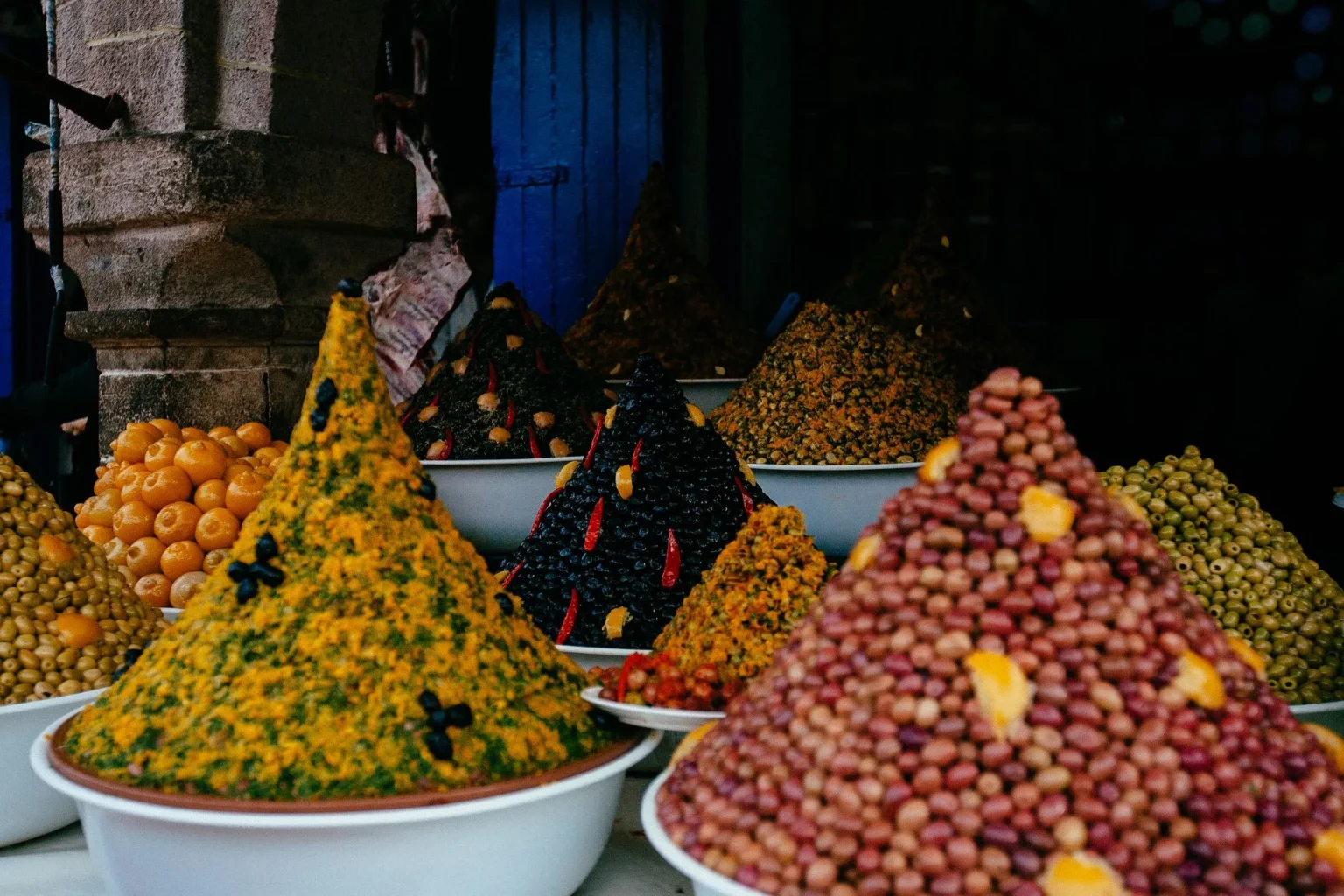

Marrakech was founded in 1070 as a garrison on the edge of the Sahara, and something of that still holds. It is a city on a threshold — the last substantial place before the mountains and the desert, and the first place the caravans reached coming north. Everything about it, including the intensity that visitors either love or flee, comes from having been a crossroads for a thousand years.
It is also the most visited city in Morocco, which means it has had decades of practice at handling people like you. That cuts both ways.
The shape of the city
Three parts, and knowing which one you are in solves most confusion.
The medina is the walled old city — roughly 19 km of rammed-earth ramparts, red because the earth is red, which is where the city’s nickname comes from. Inside: the souks, the monuments, Jemaa el-Fnaa, and almost everything you came to see. No cars.
Gueliz, the Ville Nouvelle, was laid out by the French from 1913 — wide streets, cafés, galleries, restaurants that serve alcohol, and the shops Marrakchis actually use. A fifteen-minute taxi from the medina and a useful change of pace.
The Palmeraie, north-east of the city, is a palm grove now largely given over to hotels and villas. Quiet, green, and a long way from anything.
What to see
Jemaa el-Fnaa
The square, and the reason the city has the reputation it has. UNESCO listed it in 2001 as a masterpiece of oral and intangible heritage — not for the buildings, but for what happens on it: storytellers, musicians, herbalists, snake charmers, and after dark an open-air kitchen serving several thousand people at once.
By day it is hot, exposed and aggressive in its sales technique. From about six in the evening it becomes something else entirely. Go at dusk, and see our guide to eating in the medina for what to order.
One rule: anything placed in your hands — a monkey, a snake, a henna cone — will be charged for. Photographs of performers are paid. Decide before, not after.
Koutoubia Mosque
Twelfth century, Almohad, and the tallest structure in the city at 77 metres by long-standing convention — nothing in the medina is built higher. The minaret was the model for the Giralda in Seville and the Hassan Tower in Rabat.
Non-Muslims cannot enter. The gardens beside it are open to everyone and are the best place in the medina to sit down for nothing.
Bahia Palace
Late nineteenth century, built for a grand vizier and extended by his son, and the most rewarding monument in Marrakech for most visitors. Courtyards, painted cedar ceilings, zellij, and a sense of domestic scale that the ruined palaces do not give you.
Go early. By eleven it is full.
El Badi Palace
Built by Ahmad al-Mansur from 1578, financed by a victory over the Portuguese, and stripped almost entirely by Moulay Ismail a century later when he moved the capital to Meknès and took the materials with him.
What remains is a vast rectangle of red walls, sunken orange gardens and a lot of sky, with storks nesting on the ramparts. It is a ruin, and it is more atmospheric for it.
The Saadian Tombs
Sealed up by Moulay Ismail and effectively forgotten until 1917. Two mausoleums with the finest Saadian decorative work in the country — the Chamber of the Twelve Columns in particular, in Carrara marble and carved cedar.
Small, and the queue is often longer than the visit. First thing in the morning.
Ben Youssef Madrasa
Founded in the fourteenth century and rebuilt in the 1560s, it was the largest Quranic school in Morocco, housing hundreds of students in cells around a central courtyard. It reopened in 2022 after a long restoration and it is, for many people, the single most beautiful interior in Marrakech.
Majorelle Garden and the Yves Saint Laurent Museum
The painter Jacques Majorelle laid out the garden from the 1920s and painted its structures the intense cobalt now known as Majorelle blue. Yves Saint Laurent and Pierre Bergé bought it in 1980 and saved it from development. The Berber Museum sits inside the garden; the Musée Yves Saint Laurent opened next door in 2017.
It is beautiful and it is extremely busy. Book online in advance, go at opening, and budget more time for the queue than you expect.
The souks
North of Jemaa el-Fnaa, organised historically by trade — Souk Semmarine as the main artery, then quarters for leather, metal, wood, dyers and slippers. Rahba Kedima, the old spice square, is where you buy ras el hanout, saffron and preserved lemons.
On haggling: the opening price is a starting position, not an insult. Counter without contempt, be willing to walk, and never name a number you are not prepared to pay. If you want to see what things cost first, the fixed-price government craft shop near the Koutoubia is a useful calibration.
Where to stay
Inside the medina is the right answer for a first visit of three or four nights. You wake up in the city rather than commuting into it.
Which quarter matters:
- Around Jemaa el-Fnaa — convenient and loud.
- Mouassine and Dar el Bacha — quieter, best for the souks, the highest concentration of well-restored houses.
- The Kasbah, in the south near the Saadian Tombs — calmer, slightly removed from the shopping.
- Riad Laarous — more space for less money, further to walk.
Outside the walls makes sense for a week, with children, or if a real pool matters. Hivernage holds most of the large hotels; the Palmeraie holds the resorts.
Before booking anything in the medina, read our guide to choosing a riad — the room you get inside a given house matters more than the house.
Getting around
On foot in the medina. There is no alternative; cars cannot enter.
Petit taxis are beige in Marrakech, metered, and restricted to the city. Insist on the meter. If the driver refuses, take the next one.
Calèches, the horse-drawn carriages, run fixed tourist circuits from the square. Agree the price and the route first.
From the airport, Marrakech Menara is about fifteen minutes from the medina. There is a fixed official rate; it is posted and drivers will still try to negotiate upward. A transfer arranged by your riad removes the argument entirely and is worth it on arrival.
Day trips
The Atlas Mountains — the Ourika valley and Imlil are both about an hour and a half, and both give you snow-capped peaks, walking and a temperature drop of ten degrees.
Essaouira — two and a half to three hours to the coast, doable in a day but much better as an overnight.
Ouzoud Falls — around three hours, a 110-metre waterfall with resident macaques.
The Sahara — Merzouga is nine to ten hours away. The standard purchase is a two-night trip. Anything selling you the desert as a day trip from Marrakech is selling you a bus.
When to come
March to May and October to November are the best months — warm days, cool evenings, the Atlas still with snow on it in spring.
June to August is genuinely hot. Marrakech regularly passes 40°C and the medina holds it. If you come in summer, do the monuments before ten, disappear in the afternoon, and re-emerge at six. Hotel rates drop accordingly.
December to February is mild by day and cold at night, and the riads are stone buildings with courtyards open to the sky. Check the heating before booking.
Ramadan shifts everything: quiet days, extraordinary evenings, and reduced daytime food service outside hotels. The dates move each year.
Practical
- Cash. Card acceptance is normal in Gueliz and the hotels, patchy in the medina. Small notes.
- Getting lost is guaranteed and largely harmless. Mapping apps work imperfectly inside the souks. Walking downhill and outward eventually brings you to a wall, and the walls have gates.
- Unofficial guides will offer to show you the way. If you accept, you are agreeing to a tip and usually to a shop visit. A firm, friendly no is understood.
- Dress. Marrakech is the most relaxed Moroccan city about this, and covered shoulders and knees still make life easier in the souks.
- Friday is the quiet day. Many workshops close around midday prayers.
The 2023 earthquake
The earthquake of 8 September 2023 had its epicentre in the High Atlas, in Al Haouz province south of the city. The mountain villages took the worst of it. In Marrakech itself there was damage to parts of the medina, including sections of the historic walls and some monuments, and restoration work has continued since.
The city is open and functioning normally. If you are visiting the Atlas, be aware that some villages are still rebuilding and that spending money locally there is more useful than avoiding the area.
Three days, in order
Day one: Bahia Palace at opening, then the Saadian Tombs and El Badi, then lunch in the Kasbah. Afternoon off. Jemaa el-Fnaa from six.
Day two: Ben Youssef Madrasa early, then the souks with no particular destination. Afternoon in Gueliz — Majorelle if you have booked it, a proper coffee, a restaurant with a wine list.
Day three: out. The Ourika valley or Imlil, back by evening.
Marrakech rewards a low-ambition itinerary. Two monuments a day and a long lunch will show you more of the city than five and a forced march.
