

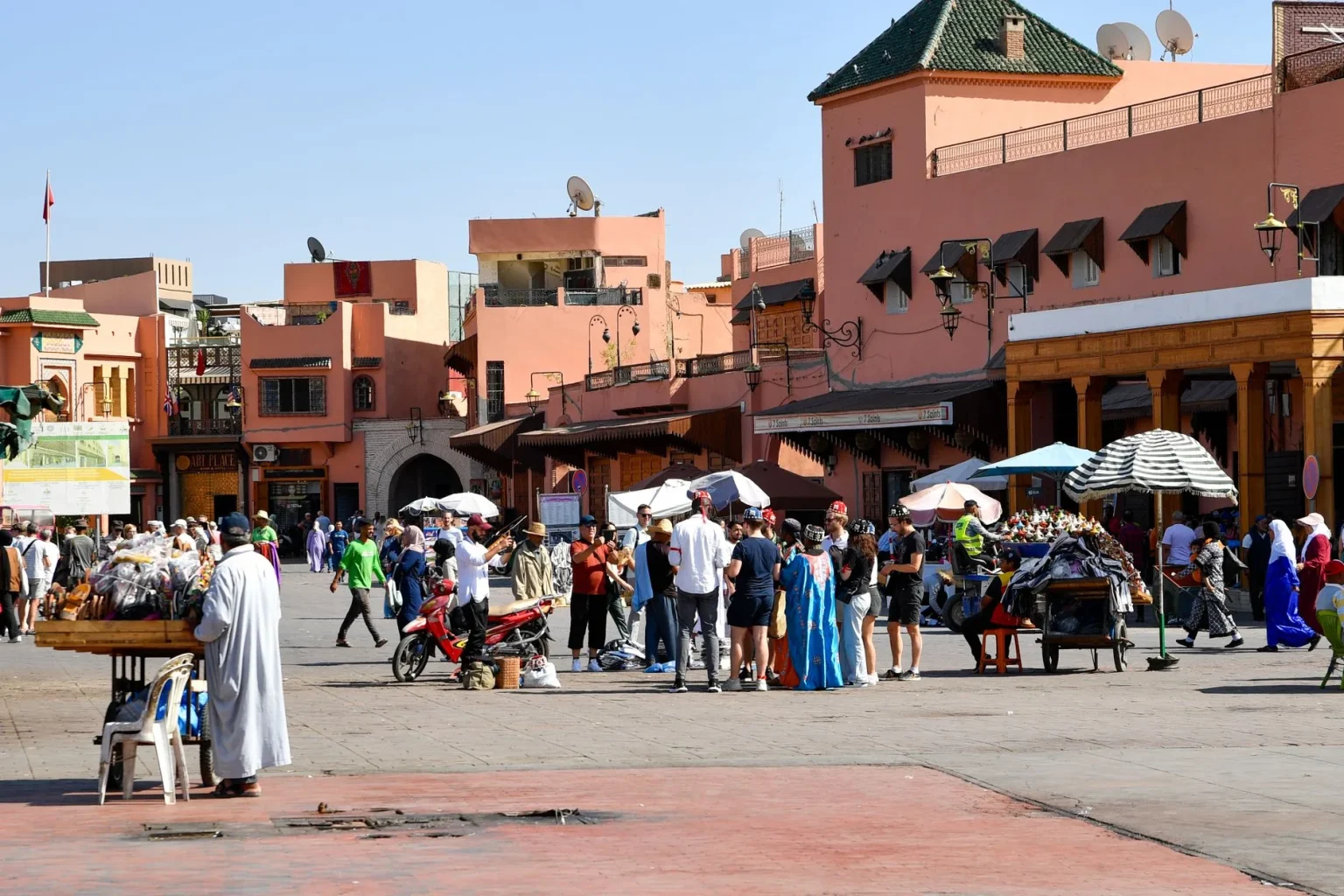

Marrakech feeds two populations with two different systems, and they overlap less than you would think.
There is the rooftop economy — restaurants selling a view of the Koutoubia with a tagine attached, priced for people on holiday. And there is the medina’s own food: stalls, hole-in-the-wall counters and furnace-cooked meat that Marrakchis have been eating for generations and that costs a fraction as much.
Both have their place. This is a guide to the second one.
Jemaa el-Fnaa after dark
The square transforms at dusk. Through the day it belongs to orange-juice carts, snake charmers and henna artists. From around six in the evening, trestle tables and gas burners are wheeled out and the whole space becomes an open-air kitchen serving several thousand people at once.
How it works: each numbered stall has a caller whose job is to get you to sit down. This is theatrical rather than aggressive, and it is part of the experience. Once you sit, food arrives quickly.
What to eat. Grilled meat — brochettes of lamb, beef and merguez — is the default and it is good. Look for the stalls with the longest queue of Moroccans rather than the loudest caller.
Harira, the tomato-and-lentil soup, is sold from dedicated counters for a very small amount of money, usually with a hard-boiled egg and a handful of dates on the side.
Snails — babbouche — are cooked in a broth heavy with liquorice root, thyme and other herbs, ladled into a bowl, eaten with a pin, and the broth drunk afterwards. It is regarded as a remedy as much as a dish. This is the thing most visitors walk past and should not.
Sheep’s head is sold at a handful of stalls and is exactly what it sounds like. The cheek meat is excellent. Whether you want to find that out is your call.
Practical notes. Prices should be confirmed before the food arrives — not because anyone is dishonest, but because “bread and olives” appearing on the table unrequested is normal and will appear on the bill. Bring small notes. The stalls that turn over fastest are the ones to sit at.
Mechoui Alley
Tucked off the square near the entrance to the souks, a short row of stalls sells nothing but whole lamb, slow-roasted overnight in underground clay pit ovens.
You order by weight. A man reaches into the pit with a hook, pulls out a section, carves it in front of you and hands it over with cumin, salt and bread. There is no menu and nowhere comfortable to sit.
It is some of the best meat you will eat anywhere. Go early — they cook a set quantity and when it is gone, it is gone, usually by early afternoon.
Tanjia
Marrakech’s own dish, and the one to make an effort to find.
Beef or lamb goes into a tall clay urn with preserved lemon, garlic, cumin, saffron and smen — aged fermented butter. The urn is sealed and buried in the ash pit of a neighbourhood hammam furnace, where it cooks for five or six hours in residual heat.
Traditionally it is bachelors’ food: prepared by men, dropped at the furnace in the morning, collected in the afternoon. The meat comes out collapsing and deeply savoury, with a slightly funky edge from the smen that is the whole point.
Few tourist restaurants make it properly, because it cannot be cooked to order. Ask at your riad — most will know a place, and some will arrange one with a day’s notice.
Breakfast in the medina
Skip the hotel buffet at least once.
Msemen and baghrir are made on griddles at street counters from early morning — the first square and laminated, the second a yeasted semolina pancake covered in holes — served with butter and honey.
Sfenj, doughnuts fried in vats of oil, are handed to you threaded on a loop of palm frond. They are best in the first minute.
Bissara, thick fava bean soup finished with olive oil and cumin, is sold from counters near the souks and is a full breakfast for pocket change.
These are morning-only. By eleven the griddles are cold.
The souks and around
The lanes north of the square hold the food that is not performing for anyone.
Rahba Kedima — the spice square — is where you buy ras el hanout, saffron, preserved lemons and dried rosebuds. The sellers around the edges will grind a blend for you. Prices are negotiable and start high.
Mellah market, in the old Jewish quarter to the south, is the best fresh produce in the medina and the least touristed. The olive stalls in particular are worth the walk.
Juice carts on the square press oranges to order. Confirm the price, take the glass rather than a bottle, and watch it pressed.
Sitting down
When you do want a table, the rule is simple: the further from Jemaa el-Fnaa, the better the cooking and the lower the price.
The rooftop places immediately around the square are selling the view. One evening there for the sunset over the Koutoubia is worth doing, and expectations of the kitchen should be modest.
Small family restaurants in the Mouassine, Kasbah and Riad Laarous quarters — short menus, often written on a board, frequently no alcohol — are where the actual cooking is.
The best meal in Marrakech, for most visitors, is dinner cooked at their riad. It is home cooking made in a domestic kitchen, usually needs a few hours’ notice, and costs well under what a rooftop restaurant charges. Ask in the morning.
Practical
- Cash. Nothing in this guide takes a card. Small denominations.
- Right hand. Bread is the utensil and the left hand is not used for food.
- Street food safety. High turnover and cooking in front of you are the two things that matter. Grilled and fried items at busy stalls are a safer bet than anything sitting warm.
- Water. Bottled, and check the seal.
- Vegetarians do fine — bissara, vegetable tagine, zaalouk, taktouka, lentils, bread, salads. Confirm the couscous broth, which is usually meat-based.
- Ramadan shuts daytime food service almost completely and turns the evening square into something extraordinary. The dates move each year.
- Alcohol is largely absent from medina restaurants. Licensed places are mostly in Gueliz and the hotels.
One evening, done properly
Bissara or msemen for breakfast at a street counter. Mechoui Alley at midday, standing up, with bread and cumin. Nothing much in the afternoon. Then Jemaa el-Fnaa from about seven: harira first, a bowl of snails if you are willing, brochettes from whichever stall the locals are queuing at, and an orange juice on the way out.
That is a full day of eating in Marrakech for less than the cost of one rooftop dinner, and it is the version of the city that was there before anyone came to look at it.
For the wider picture — what the dishes are, where they come from and how the regions differ — see our complete guide to Moroccan cuisine.
