


Marrakech is the city most people see. Fès is the city Moroccans send you to when they want you to understand something.
Fès el-Bali — the old medina — was founded at the end of the eighth century and has been continuously inhabited ever since. It holds somewhere around nine thousand lanes, no cars, a university older than Oxford, and a working leather tannery that has been operating on the same site since roughly the eleventh century. UNESCO listed it in 1981. It is, by most measures, the largest car-free urban area in the world.
It is also the single most disorienting place in Morocco, and there is no version of a first visit in which you do not get lost. Plan around that rather than against it.
How the medina is organised
Fès el-Bali is not laid out on a grid and it was never planned in the modern sense. It grew, over twelve centuries, around water and trade.
Two things make it legible once you know them. The first is that the medina sits in a bowl, sloping down towards the river. Walk downhill and you are heading towards the centre — Al-Qarawiyyin, the main souks, the tanneries. Walk uphill and you are heading for a gate. When you are thoroughly lost, this is the most useful fact you have.
The second is that the souks are organised by trade, not by geography, and always have been. There is a street of coppersmiths, a street of dyers, a quarter for wood, a quarter for leather, a spice market. You hear where you are before you see it: hammering, then the smell of cedar shavings, then cumin. Once you start navigating by trade rather than by street name — there are hardly any street names — the medina stops being random.
The main artery is Talaa Kebira, which runs down from Bab Boujloud towards Al-Qarawiyyin. Talaa Seghira runs parallel and rejoins it. If you learn one route in Fès, learn this one.
What to see
Al-Qarawiyyin
Founded in 859 by Fatima al-Fihri, the daughter of a merchant, who used her inheritance to build it. It has functioned as a mosque and a centre of learning ever since, which makes it the oldest continuously operating degree-granting institution in the world — a claim that appears in the Guinness records and, more importantly, is broadly accepted by historians.
Non-Muslims cannot enter the mosque. You can look in through the doorways, and from certain rooftops you can see the courtyard and the green-tiled roofs.
The library is a different matter. It holds manuscripts going back over a thousand years, was restored and reopened in 2016 under the Moroccan-Canadian architect Aziza Chaouni, and part of it is now accessible to visitors. Check current access before you go — it has changed more than once.
The madrasas
These are the buildings to prioritise, because they are the ones you can actually go inside.
Bou Inania (1350–1355) is the largest and the most elaborate — a Marinid theological college with carved cedar, stucco filigree and zellij worked to a standard that is difficult to take in at first viewing. It is unusual among Moroccan madrasas in having a full minaret, and unusual in Fès in being open to non-Muslims.
Al-Attarine (1323–1325) sits beside the spice and perfume market that gives it its name. It is smaller, and many people find it the more beautiful of the two: a tight courtyard with a marble basin, and every surface above head height worked in plaster and cedar.
Both take under an hour. Do them early, when the light comes down into the courtyards.
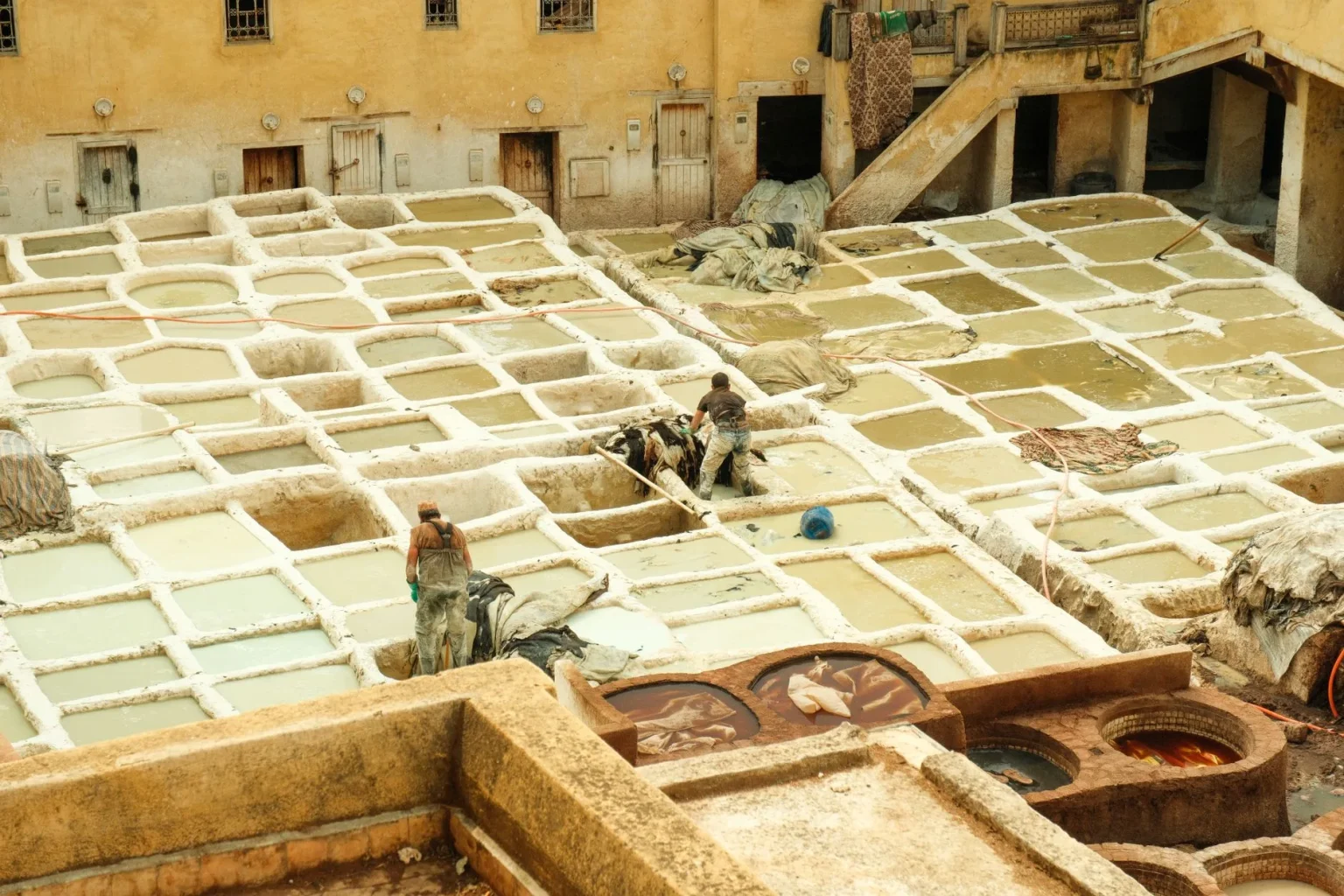
The Chouara tannery
The image everyone knows: stone vats of dye and lime, arranged in a honeycomb, worked by men standing waist-deep.
The process has barely changed. Hides are soaked in a mixture that includes lime and pigeon droppings to strip hair and soften the leather, then moved to the dye pits — poppy for red, indigo for blue, henna for orange, saffron for yellow, mint for green.
You view it from the terraces of the leather shops that surround the pits. You will be handed a sprig of mint at the door. Use it; the smell in high summer is genuinely difficult. There is no official ticket — access is through the shops, and there is an expectation, explicit or otherwise, that you will look at the goods and tip on the way out. Decide in advance what that is worth to you and the transaction is straightforward.
Go in the morning. By afternoon the terraces are crowded and the light is flat.
Bab Boujloud
The Blue Gate, and the main western entrance to the medina. It is not ancient — it was built in 1913, under the French protectorate — but it is the landmark everyone orients by. Blue on the outside facing the new city, green on the inside facing the medina.
Nejjarine
A small square holding a monumental fountain and the Nejjarine Museum of Wooden Arts and Crafts, housed in a restored eighteenth-century caravanserai. The museum is quiet, well-presented, and has a rooftop café with one of the better views over the medina.
Fès el-Jdid and the Mellah
The “new” Fès, founded in the thirteenth century by the Marinids. It holds the Royal Palace — you cannot go in, but the brass doors on Place des Alaouites are extraordinary and everyone photographs them — and the Mellah, the historic Jewish quarter.
The Mellah is architecturally distinct: balconies face the street here, which they never do in the Muslim medina. The Ibn Danan Synagogue, restored with international support, is open to visitors, and the Jewish cemetery above it is worth the walk.
The viewpoints
The Merinid Tombs, on the hillside north of the medina, are ruined and unremarkable up close. The view is the point: the whole medina laid out below, best in the last hour before sunset, with the call to prayer starting from a dozen minarets at once. Borj Nord, the sixteenth-century fortress nearby, offers a similar view and houses an arms museum.
Guides
Fès is the one Moroccan city where hiring a guide for the first day is the obvious decision rather than a matter of taste.
Use an official guide — they are licensed, carry a badge, and can be booked through your riad or the tourist office. The unofficial ones who attach themselves to visitors at Bab Boujloud will show you some of the city and a great deal of their cousin’s carpet shop.
Agree the itinerary beforehand and be explicit about shopping: say clearly whether you want to visit workshops or not. A good guide will respect that. Half a day is enough to learn the shape of the medina; after that you can walk it yourself, badly, which is the better way to see it.
Practicalities
- Nothing has an address you can use. Riads give directions relative to a gate or a landmark. Screenshot the directions before you arrive and ask to be collected on the first night.
- Mules have right of way. Goods still move through the medina on animals and handcarts. The shout is balak — it means get out of the way, and you should.
- Shoes. Steep, uneven, frequently wet underfoot near the tanneries and the dyers’ quarter.
- Cash. Small notes, and more of them than you think.
- Dress. Fès is markedly more conservative than Marrakech. Covered shoulders and knees.
- Friday. Many workshops close for midday prayers and some stay shut. It is a quiet, pleasant day to walk the medina and a bad day to shop.
When to come
Fès sits inland in a basin, and the climate is continental rather than coastal. July and August are hot — regularly into the high thirties, occasionally beyond — and the medina holds the heat.
March to May and September to early November are the windows. Warm days, cool evenings, walkable.
Winter is cold and damp, with real rain. The riads are stone and the courtyards are open to the sky; check the heating before you book.
The Fès Festival of World Sacred Music, usually held in late spring, fills the city and is worth planning around in either direction depending on what you want.
How long
Three nights. Two is the minimum and it will feel rushed.
Day one with a guide, to get the geography and the major monuments. Day two on your own, deliberately without a plan, which is when Fès actually happens — you follow a smell or a noise, end up in a courtyard where four men are making brass lanterns, and lose two hours. Day three for Fès el-Jdid, the Mellah and the viewpoints, or for a trip out to Volubilis and Moulay Idriss, both around an hour away.
Why it is worth the difficulty
Marrakech has largely worked out what visitors want and supplies it efficiently. Fès has not, and shows little sign of wanting to.
The medina is not a preserved quarter with a working city beside it. It is the working city. The men in the tanneries are not performing; the tannery is a business with contracts. The students at Al-Qarawiyyin are students. The mule blocking the lane is carrying gas cylinders to someone’s kitchen.
That is the reason to come, and it is also why you will get lost. A place organised around its own life rather than around your route through it does not offer many signposts.
Take the guide on the first day. Then put the map away.
