

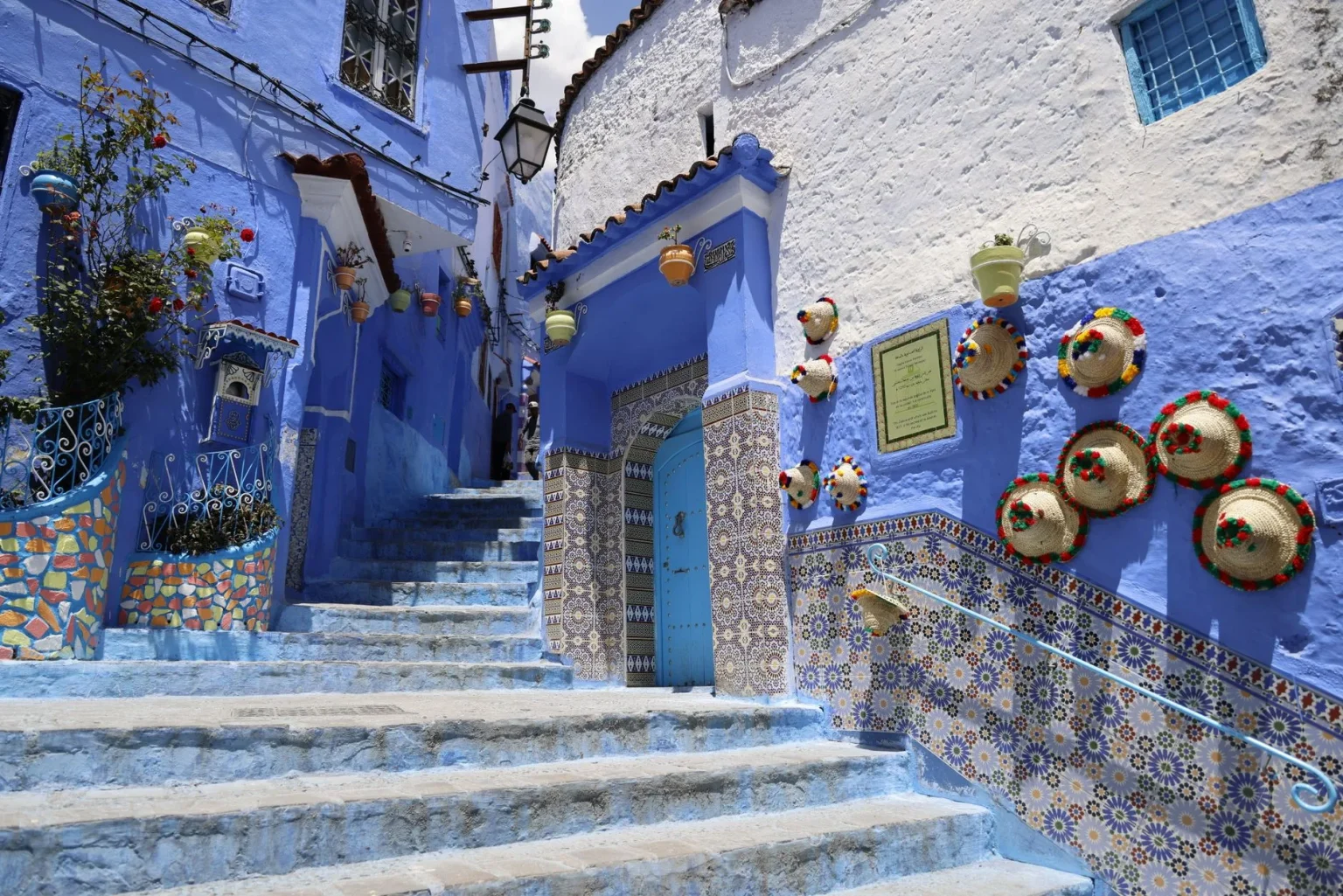

The first thing you notice about Chefchaouen is not the blue. It is the altitude. The town sits at around 600 metres in the folds of the Rif, and the air arrives cool and thin even in July, carrying woodsmoke and the smell of wet stone. The blue comes second, and it comes gradually — a doorframe here, a stairwell there — until you turn into the lanes above Plaza Uta el-Hammam and the whole hillside has been painted the colour of a swimming pool.
It is a small place. You can walk the medina end to end in twenty minutes. That is worth knowing before you arrive, because a great deal of what is written about Chefchaouen suggests a city, and it is not one. It is a mountain town of roughly 40,000 people that happens to have become one of the most photographed places in North Africa, and it is currently working out what to do about that.
Why the town is blue
Ask ten people in Chefchaouen and you will get four answers, all delivered with total confidence.
The version most often repeated to visitors is that Jewish refugees arriving from Europe in the 1930s brought the practice with them, blue being a colour of significance in Jewish tradition. The town did take in a Jewish population, and the timing roughly fits. But older residents will tell you the lime wash was originally white and pale green, and that the blue spread through the medina within living memory — some say from the 1970s, some later.
The second explanation is practical: blue-tinted lime wash discourages mosquitoes. The third is thermal — pale blue reflects heat, and the lanes do run noticeably cooler than the open square. The fourth, offered with a shrug by a man repainting his own doorstep near Bab El-Ain, is the most honest: it brings people, and people bring money.
All four are probably true in part. What is certain is that the colour is maintained, deliberately and continuously. The lime wash is renewed by hand, usually before the spring season, and the shade varies street by street because families mix their own. Look closely and you will see six or seven distinct blues within a single alley.
Getting there
Chefchaouen has no airport and no railway station. Everyone arrives by road, and the road you take shapes the day.
From Tangier it is roughly 110 km and around two hours by car. This is the easiest approach and the one most visitors use, often as a day trip — which is a mistake, but more on that below.
From Tetouan it is about an hour. Tetouan is the nearest city of any size and has an airport with seasonal European connections.
From Fès it is roughly 200 km and four hours, on a road that climbs steadily through the Rif and is genuinely beautiful for the last ninety minutes. If you are travelling Fès to Tangier, routing through Chefchaouen costs you very little.
CTM runs scheduled coaches from all three cities and is the operator to use — fixed seats, fixed fares, luggage handled properly. Book ahead in spring and autumn; the Tangier and Fès services fill. Grands taxis run the same routes faster and leave when full rather than on a timetable.
The bus station sits below the medina. It is a fifteen-minute walk uphill with a bag, or a short petit taxi ride. Cars cannot enter the medina. If you are driving, park in one of the lots outside Bab El-Ain and walk in.
How long to stay
Two nights. One is the common choice and it is the wrong one.
The town has two entirely different characters depending on the hour. Between roughly ten in the morning and five in the afternoon, coaches arrive from Tangier and the main lanes fill. The famous staircases have queues. The cats are professionally photogenic and the shopkeepers have seen it all.
Then the coaches leave, and by seven in the evening the medina belongs to the town again. Children play football in the square. Men take tables outside the cafés under the Kasbah wall. The light drops and the blue goes violet. This is the Chefchaouen worth coming for, and you cannot see it on a day trip.
Mornings are the other reward. The lanes are empty before eight, the lime wash is still damp with dew, and the light falls straight down the north–south alleys.
What to see in the medina
Plaza Uta el-Hammam
The main square, shaded by mulberry trees, lined with cafés on one side and the Kasbah on the other. Every visitor passes through it. The café prices reflect that; walk one street back and they halve.
The Kasbah and its gardens
Built in the seventeenth century under Moulay Ismail, on the site of the original fortress. The walled garden inside is the quietest place in the centre of town, and the small ethnographic museum is worth the modest entry fee for the photographs of Chefchaouen before the blue — white walls, green shutters, an ordinary Rif town. The tower gives you a rooftop view over the square.
The Grand Mosque
Fifteenth century, notable for an octagonal minaret that is unusual in Morocco. Non-Muslims cannot enter, but the exterior is the architectural anchor of the square.
Ras El Maa
The spring at the eastern edge of the medina, where the water comes out of the mountain and runs down through open channels. Women still bring laundry here. There are cafés built into the rock above the stream, and the sound of running water carries surprisingly far into the town. Follow the path up from here and you leave the medina almost immediately.
The Spanish Mosque
Built by the Spanish in the 1920s, during the protectorate, on the hill facing the town. It was never used for prayer — accounts differ on why, but local resentment of the occupying administration features in all of them. It stood empty and roofless for decades and has since been partially restored.
The walk up takes about thirty minutes from Ras El Maa, on a stony path with no shade. Go for sunset, go with water, and go in shoes you do not mind scuffing. The view back over the medina, with the whole blue quarter stacked against the mountain, is the photograph everyone comes for, and unlike the staircases it does not require a queue.
Getting out of town
Chefchaouen sits at the edge of Talassemtane National Park, and the mountains are the reason to add a third night.
Akchour is around 30 km north, reached by grand taxi in about forty minutes. Two walks start from the same point. The shorter one leads to the Pont de Dieu — God’s Bridge — a natural rock arch roughly 25 metres above the riverbed. The longer one follows the river to a series of waterfalls, with pools cold enough to hurt and cafés set up on platforms along the way. Allow most of a day for the falls. It is not technical walking, but it is three to four hours of it, much of it on rock, and in summer the river draws crowds.
Jebel El-Kelaa is the peak directly above the town, at 1,616 metres. It is a serious half-day climb with real exposure near the top and no facilities. Take a local guide; the paths fork repeatedly and the weather on the ridge changes fast.
A word on the Rif more generally: this is cannabis-growing country, and it has been for a very long time. Visitors are approached, particularly on the walking paths and after dark near the edges of the medina. The substance is illegal in Morocco. A polite, unambiguous no is understood and is the end of it.
Eating
Chefchaouen cooks mountain food, not coastal food, and it does a few things very well.
Bissara — dried fava bean soup, thick as porridge, poured into a bowl and finished with olive oil, cumin and a dusting of paprika — is the breakfast of the Rif. It is sold from small counters around the square from early morning and it costs almost nothing. Eat it standing up with bread.
Goat cheese is the local speciality, made in the villages around the town, sold fresh and soft in the market and often served grilled with honey. It is unlike anything else you will eat in Morocco.
Tagine here tends towards lamb with prunes or chicken with preserved lemon, and the vegetables are genuinely local — the Rif is fertile and the market reflects it.
The rooftop restaurants around the square trade on the view rather than the kitchen. The better cooking is in the small family places on the lanes running north from Plaza el-Haouta, where the menu is short and written on a board.
When to come
April to early June is the best window. The Rif is green, the wildflowers are out, walking is comfortable and the town has not yet reached peak season.
September and October are the second choice — warm, dry, and quieter than the summer.
July and August bring both heat and domestic tourism. Moroccan families holiday here to escape the coastal humidity, and the town is at its fullest.
December to February is cold and wet, with snow on the higher Rif and frequent low cloud that swallows the town for days. Some riads close. If you come, come for the emptiness and bring layers — the buildings are stone and very few have heating worth the name.
Practicalities
- Cash. Card acceptance in the medina is patchy. There are ATMs near Bab El-Ain and in the new town. Carry small notes; change is a perennial problem.
- Shoes. The medina is built on a slope and paved in worn, rounded stone that becomes slick in rain. Sandals are a bad idea.
- Dress. Chefchaouen is conservative by the standards of Marrakech or Casablanca. Covered shoulders and knees will save you unwanted attention, particularly away from the main square.
- Photography. People live behind those doors. Several households have put up hand-written signs asking visitors not to photograph their entrances, and a number now charge for the privilege. Ask, or move on.
- Language. Darija and Tarifit in the street, Spanish more widely understood than French — a legacy of the protectorate — and English in the tourist trade.
Is it worth it
Chefchaouen has been thoroughly discovered, and there is no point pretending otherwise. In the middle of an afternoon in May it can feel like a set.
But the town underneath is still there, and it is not difficult to reach. Stay the second night. Get up early. Walk up to the Spanish Mosque in the last hour of light and then come back down into the square when the day-trippers have gone. What you are looking at is not a colour scheme — it is a Rif town that has been repainting itself by hand for decades and has decided, collectively and without any obvious coordination, to keep doing it.
That is more interesting than blue.
