

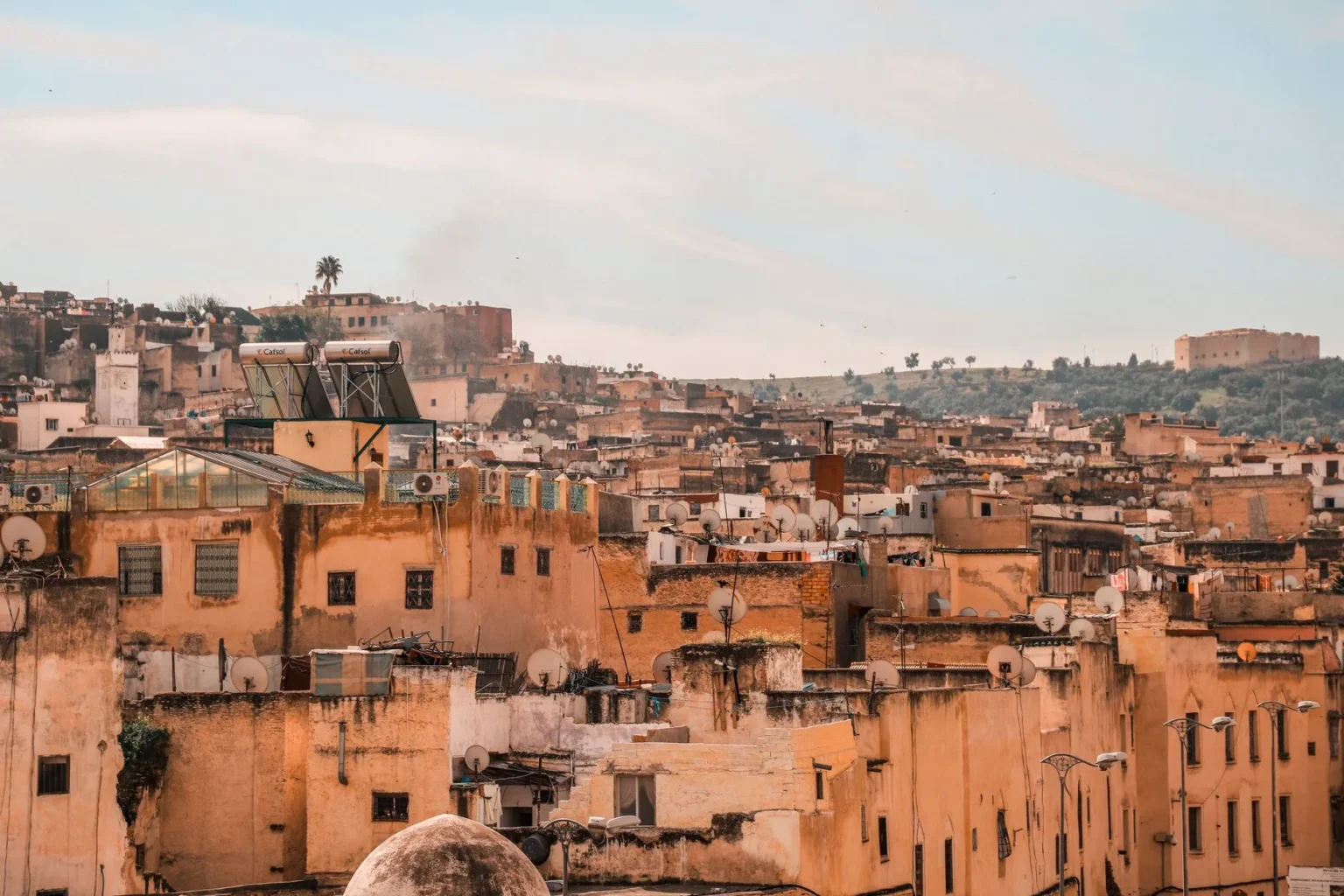

Tangier spent most of the twentieth century being described by people who were not from there. The International Zone years — roughly 1923 to 1956, when the city was administered jointly by several European powers and belonged properly to none of them — produced a reputation for smuggling, espionage and expatriate writers that the city has been carrying ever since.
That Tangier is gone. What replaced it is more interesting: a working port city of over a million people, with the largest container terminal in the Mediterranean, a high-speed rail link to Casablanca, and a seafront that has been comprehensively rebuilt.
Come for the geography, which has not changed. Tangier sits at the Strait of Gibraltar, fourteen kilometres from Spain. On a clear day you stand on the hill above the city and look at Europe.
What to see
The Kasbah
The fortified quarter at the top of the medina, and the best part of the city. Whitewashed lanes, blue doors, and views over the strait from almost every gap between buildings.
The Kasbah Museum, in the former sultan’s palace of Dar el Makhzen, covers Moroccan history from prehistory through the Roman period and is worth an hour for the building alone — courtyards, painted ceilings, and a small Andalusian garden.
Around it, the Kasbah has become the smart quarter: restored houses, a handful of good small hotels, and a couple of terraces where you can sit with a coffee and watch the ferries cross.
The medina
Smaller and less intense than Fès or Marrakech. The Petit Socco — the small square that was the centre of the International Zone’s café life — is where most of the literary mythology is set. It is an ordinary square with cafés on it, and the cafés are perfectly good.
The Grand Socco, properly Place du 9 Avril 1947, is the hinge between the medina and the new city, with the Cinema Rif on one side — a restored 1930s cinema that now runs as an arthouse and a café, and is the best place in Tangier to sit down.
Cap Spartel and the Caves of Hercules
Fourteen kilometres west, where the Atlantic and the Mediterranean meet. The lighthouse dates from the 1860s and the point is marked, inevitably, with a sign telling you which sea is which.
Just below, the Caves of Hercules open onto the Atlantic through a gap that, from inside, has a rough resemblance to the map of Africa. The caves were quarried for millstones over centuries, which is why the walls are covered in circular scars. It is touristy and it is still worth doing, particularly late in the day.
The road out passes the Diplomatic Forest and the beaches at Achakar, which are the best swimming near the city.
The American Legation
In the medina, and a genuine curiosity: the first property the United States government ever owned abroad, given by Sultan Moulay Suleiman in 1821. It is now a museum and research library, with a good collection of paintings of the city and a room devoted to Paul Bowles.
Morocco was the first country to recognise the independence of the United States, in 1777. The Legation is the physical trace of that.
The Marina and the Corniche
Tangier’s seafront was rebuilt over the last decade — the old port moved out to Tanger Med, forty kilometres east, and the space it left became a marina, a cruise terminal and a long promenade.
It is where the city walks in the evening. Not historic, entirely pleasant, and the clearest sign of what Tangier is now rather than what it was.
Day trips
Asilah — 45 minutes south. A small walled town with whitewashed ramparts, blue doors and an annual mural festival that has covered the medina in contemporary painting. Paradise Beach is a few kilometres further. It is the best half-day from Tangier.
Chefchaouen — about two hours. Doable as a day trip and much better overnight; see our Chefchaouen guide.
Tetouan — an hour east. A UNESCO-listed medina with a strong Andalusian character, very few foreign visitors, and the best pastry in northern Morocco.
Cap Malabata — east along the bay, for the view back at the city.
Getting there and around
By train. Al Boraq, the high-speed line, reaches Casablanca in a little over two hours, with Rabat in between. It is the fastest and most comfortable way into or out of Tangier, and second class is inexpensive.
By ferry. From Tarifa in Spain, around an hour, arriving at Tangier Ville port in the city itself — this is the crossing to take. From Algeciras, longer, and arriving at Tanger Med, forty kilometres out with a shuttle into town. Check which port your ticket actually uses.
By air. Ibn Battouta airport takes European flights and sits fifteen kilometres from the centre.
In the city, petit taxis are ultramarine blue and metered. Insist on the meter. The medina and Kasbah are walkable; everything else is not.
Where to stay
The Kasbah for atmosphere — small restored houses with terraces over the strait. Quiet, characterful, and a walk uphill with luggage.
The medina for convenience and lower prices.
The Corniche and the Ville Nouvelle for large hotels, sea views and a pool.
Tangier is noticeably cheaper than Marrakech at every level.
When to come
May, June, September and October are the best months — warm, clear, and the strait at its calmest.
July and August bring heavy domestic tourism and large numbers of Moroccans living in Europe returning for the summer, particularly through the ferry ports. The city is at its liveliest and its most crowded.
Winter is mild, wet and windy. The Levante, the easterly wind through the strait, can blow hard for days at a time and will cancel ferries.
Practical
- Spanish is widely spoken, often more usefully than French, and English is common in the tourist trade.
- Two currencies in the head. Prices near the ferry terminal are quoted with day-trippers from Spain in mind. Walk inland.
- Faux guides operate around the port and the Grand Socco, more persistently than elsewhere in Morocco. A firm no works.
- The city is liberal by Moroccan standards but it is not a resort. Dress accordingly away from the beaches.
- Cash in the medina; cards in the Ville Nouvelle.
How long, and what it is for
Two nights. Tangier is not a city of monuments — the list of things to see is short and none of them will take your breath away. What it has is position and atmosphere.
The right use of it is as a start or an end. Arrive by ferry from Spain, spend two nights, then take Al Boraq south and let the country open up. Or come north at the end of a trip, sit in the Kasbah looking at Europe, and think about the fact that the distance is fourteen kilometres and has always mattered enormously.
That view is the reason the city exists, and it is still the best thing in it.
