

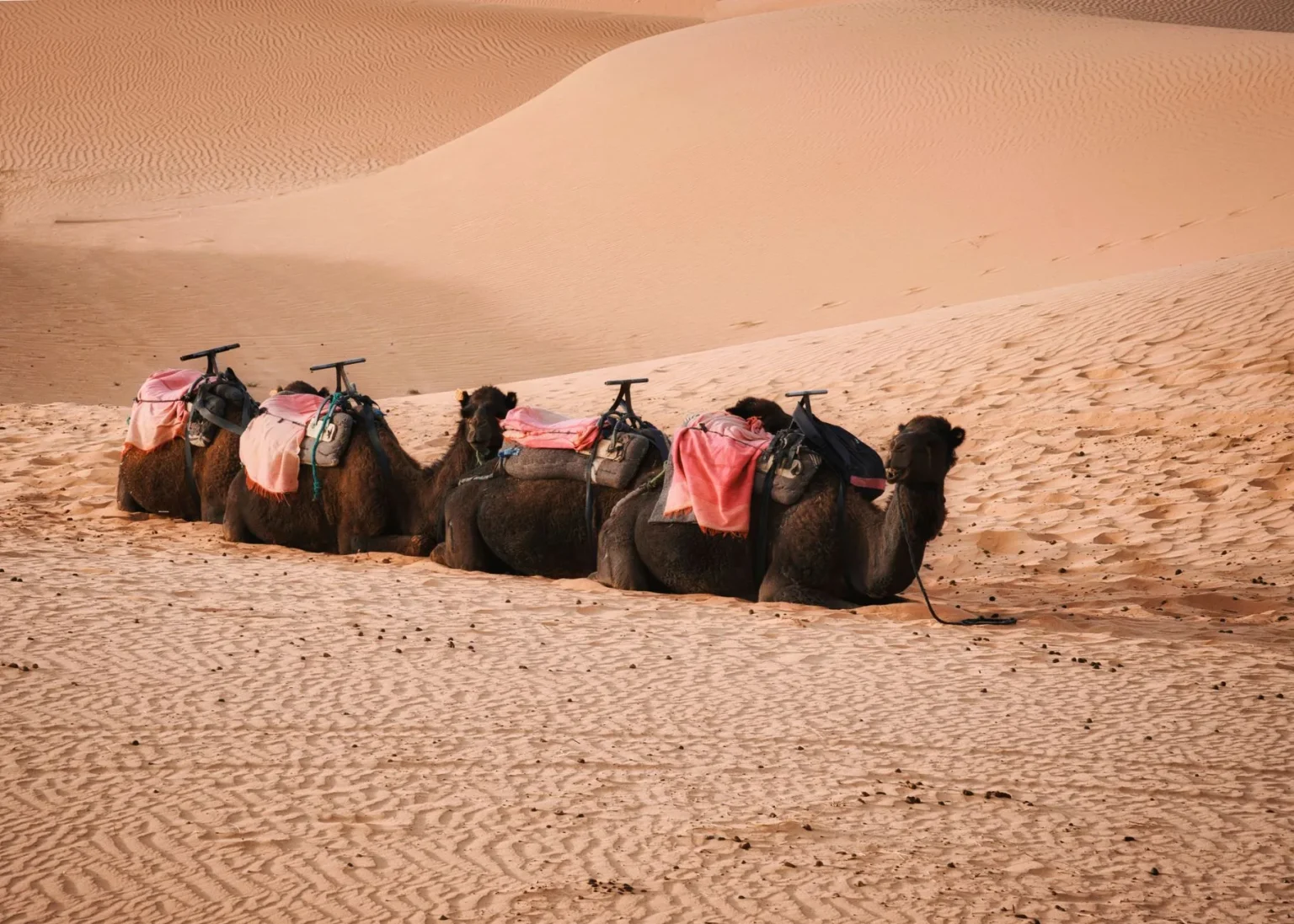

Some places never truly let you go. The Moroccan Sahara is one of them. After twenty years of travel across 107 countries, I can say it without hesitation: no landscape has ever stopped my breath like the dunes of Erg Chebbi at sunset.
The sun descends slowly over the sandy horizon, painting the dunes in burnt orange, pompeian red, ancient violet. Your camel sways rhythmically forward. No Wi-Fi. No traffic noise. Just wind sculpting perfect waves across the sand — and at night, once every lamp is out, a Milky Way so dense it looks painted overhead.
This guide is the result of multiple visits to Merzouga and the Erg Chebbi region. I’ll tell you everything: how to get there, where to sleep, what to do, how to avoid the tourist traps — and most importantly, how to experience the Sahara the right way.
🏜 What Is Erg Chebbi — and Why It’s Unlike Anything Else
Updated: August 2026 · 12 min read
Erg Chebbi is a sea of sand roughly 22 km long and 5 km wide, located in southeastern Morocco just a few kilometres from the village of Merzouga. Its dunes reach up to 150 metres in height, making it one of the most spectacular dune fields in the entire northern Sahara.
What makes Erg Chebbi truly unique is the mineral composition of its sand: rich in iron oxide, it shifts from pale gold at dawn to deep pompeian red at sunset. It’s this colour — not just the scale — that draws an involuntary gasp the first time you see it.
✈️ How to Get to Merzouga
By Car from Marrakech
9–10 hours via Ouarzazate and Tinghir. A spectacular route through the High Atlas — the most scenic approach to the desert.
⭐ Recommended
CTM / Supratours Bus
Departures from Marrakech and Fès. Comfortable and budget-friendly, though schedules are limited. Change at Erfoud or Rissani.
3-Day Organised Tour
The easiest option: private driver, riad, and desert camp all included. Departures from Marrakech or Fès.
💡 Pro tip: The nearest airport is Ouarzazate (OZZ), roughly 4 hours away, with flights from Casablanca via Royal Air Maroc. Coming from Fès? The 7–8 hour drive through the Middle Atlas is stunning and absolutely worth it.
📅 When to Visit the Moroccan Desert
20–30°C
Excellent
40–45°C
Avoid
18–28°C
Perfect
5–20°C
Cold nights
The golden window: October and November. Daytime temperatures stay comfortable (22–28°C), nights are cool but manageable, and the light for photography is extraordinary. Summer months (June–August) should be avoided entirely — sand surfaces can hit 70°C and no sunset is worth a heatstroke.
🌙 For the Milky Way: plan your Merzouga visit around a new moon, from October through April. The Sahara sky with zero light pollution on those nights is simply unrepeatable.
🎯 Things to Do in Merzouga and Erg Chebbi
🏕 Where to Stay: From Berber Camp to Luxury Glamping
Accommodation in the desert splits into two main categories: dune camps (the most authentic choice) and riads/hotels in Merzouga (more comfortable, with day trips into the desert). I always recommend at least one night in a camp — that is the whole point of coming here.
Luxury Glamping
Private tent with king bed, en-suite bathroom, solar electricity, Berber candlelit dinner under the stars.
Sahara Luxury Camp, Dar Ahlam Erg
Traditional Berber Camp
Large tent with mattress, communal dinner around the fire, Gnawa music, sunrise on the dunes included.
Best for cultural authenticity
Riad in Merzouga
Full comfort, pool, air conditioning. A convenient base for daily desert excursions without roughing it.
Riad Madu, Kasbah Azalay
📌 Important: The best camps are always positioned high on the dunes, not at the base. Always ask for the exact location before booking. The difference between being “near the dunes” and “inside the dunes” is the difference between an ordinary night and a memory that stays with you for life.
🗺 The Perfect Itinerary: 3 Days in the Moroccan Desert
💼 Practical Tips from an Experienced Traveller
🎒 What to Pack
- Scarf or turban (sand and sun protection)
- Headlamp for dark desert nights
- Closed shoes for climbing dunes
- SPF 50+ sunscreen
- Portable power bank (solar charging is limited)
- Warm layer for winter nights (it gets cold)
💰 Estimated Budget
- Traditional camp: €50–80/night
- Camel return trek: €30–50
- Lunch/dinner tagine: €8–15
- Local guide half-day: €40–60
- Handicraft souvenirs: €10–50
⚠️ Tourist Traps to Avoid
- “Cheap” camps positioned at the dune base
- Visiting in summer (genuinely dangerous)
- Driving in the desert at night without a guide
- Unofficial “faux guides” at the village entrance
- Paying upfront without verified reviews
✅ Responsible Travel
- Carry all waste out of the desert
- Choose Berber-owned and operated camps
- Do not handle wildlife (fennec fox, reptiles)
- Respect camel rest periods
- Buy crafts directly from local artisans
❓ Frequently Asked Questions
Is it safe to travel to the Moroccan Sahara?
Yes. Southern Morocco is one of the safest parts of the country. The Merzouga region welcomes hundreds of thousands of tourists every year. As anywhere, use common sense: use certified guides, don’t wander into the dunes without orientation, and follow local advice.
How many nights should I spend in the desert?
At least two nights if possible. The first night you’re still in tourist mode; the second you genuinely relax. If you only have one night, invest in a high-quality camp — that single night needs to carry the whole experience.
Is there internet access in the desert camps?
Usually no — and that is one of the best things about it. A few luxury camps offer weak satellite Wi-Fi. Consider the total disconnection a feature, not a flaw. Those are the most valuable hours of the whole trip.
Is the camel trek ethical for the animals?
It varies enormously between operators. Choose camps that show camels that are well-rested, well-fed and fitted with padded saddles. Avoid any situation where the animals appear stressed or are used for more than 3 hours continuously per day.
Written by
Mohamed Bourbiza
Travel journalist with 28 years of experience, founder of Euro News Agency. He has visited the Moroccan Sahara multiple times over two decades of reporting from 107 countries.
