

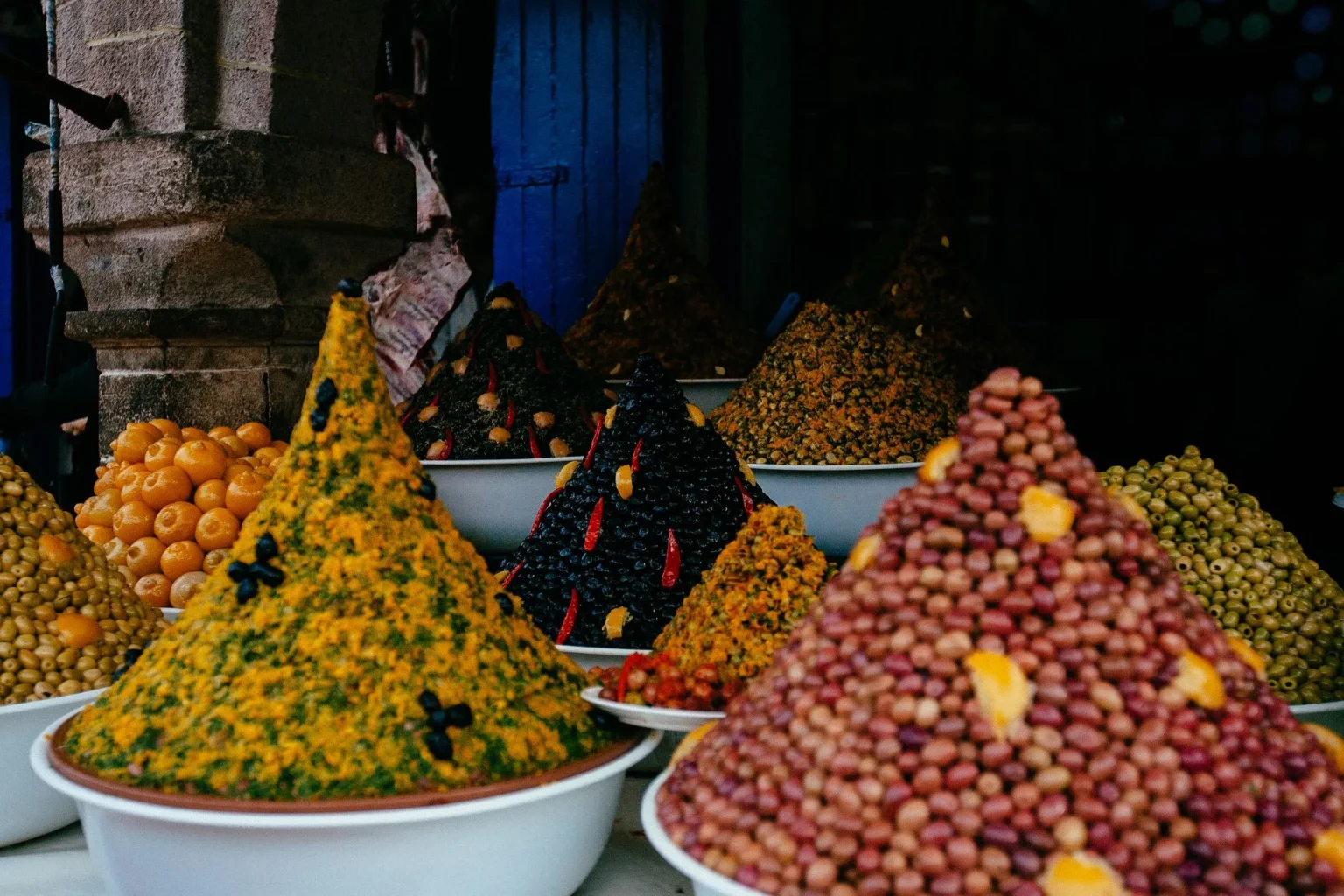

Moroccan street food is not a checklist of snacks. It is breakfast eaten standing beside a hot griddle, the smell of cumin drifting through a medina lane, sardines frying near the Atlantic and a glass of mint tea arriving before you have quite decided what to order. If you want to understand Morocco beyond monuments and hotel lobbies, start where Moroccans actually eat.
What should you try first?
Start with msemen or baghrir in the morning, maakouda or grilled sardines at lunch, and brochettes, harira or a bowl of bissara when you want something deeply local. Save room for sfenj.
Street food is one of Morocco’s best introductions
There is no single Moroccan street-food tradition. Marrakech does not eat exactly like Fès; Tangier looks toward the Mediterranean, while Essaouira and Agadir live with the Atlantic at their door. In the north you notice Spanish and Mediterranean echoes. In old imperial cities, recipes can feel more elaborate. Along the coast, fish naturally takes centre stage.
What connects these places is the rhythm. Food follows the day. Bakeries and griddles wake early. Markets become busiest around lunch. As evening arrives, smoke rises from grills and small counters fill with people ordering familiar dishes quickly and without ceremony.
10 Moroccan street foods worth knowing
1. Msemen — the breakfast you will start craving
Msemen is a layered, square flatbread cooked on a griddle until its surface becomes lightly crisp while the inside stays soft and elastic. It can arrive plain, with honey and butter, soft cheese, or filled with savoury ingredients. Fresh from the griddle with hot tea, it is one of the simplest Moroccan breakfasts and one of the easiest to love.
2. Baghrir — Morocco’s thousand-hole pancake
Baghrir is soft, spongy and instantly recognisable from the tiny holes covering its surface. Those holes are useful: they absorb melted butter and honey beautifully. It is gentler and lighter than msemen and is common at breakfast or afternoon tea.
3. Sfenj — hot, irregular and best eaten immediately
Think of sfenj as Morocco’s wonderfully imperfect doughnut: rings of yeasted dough fried until golden, crisp at the edges and airy inside. The best moment to eat one is almost embarrassingly soon after it leaves the oil.
4. Maakouda — the humble potato cake
These seasoned potato patties are fried until golden and can be eaten alone or tucked into bread with sauce and salad. Maakouda proves an important point about Moroccan street food: the memorable dishes are not necessarily expensive or complicated.
5. Bissara — comfort in a bowl
Bissara is a thick purée traditionally made from dried fava beans or split peas, served hot with olive oil, cumin and often paprika. On a cool morning it is difficult to find a more satisfying inexpensive meal. In northern Morocco especially, it belongs to everyday food culture rather than restaurant theatre.
6. Harira — much more than a Ramadan soup
Harira combines tomatoes, pulses, herbs and warming spices; recipes vary by household and region. It is strongly associated with breaking the fast during Ramadan, but you can encounter it at other times too. A good bowl feels substantial without being heavy and often comes with bread or something sweet alongside.
7. Brochettes — follow the smoke
Small skewers of seasoned meat cooked over charcoal are among the most tempting evening smells in Morocco. Lamb, beef and chicken are common. Watch for a busy grill, order what is being cooked fresh, and expect bread, cumin, salt and perhaps salad or sauce on the side.
8. Grilled sardines — Morocco between bread and sea
Morocco’s long coastline makes sardines an essential part of its everyday food story. They may be grilled simply or prepared with a chermoula-style mixture of herbs and spices. Coastal cities are the obvious places to seek them out, particularly where the fish has travelled a very short distance from harbour to plate.
9. Snail soup — for curious eaters
In some busy squares and markets you will see steaming pots of snails served in a fragrant broth. The experience is as much about the setting as the bowl itself. It will not be every traveller’s first choice, but it is unmistakably part of Morocco’s street-food landscape.
10. Fresh orange juice — simple, but location matters
Morocco grows excellent citrus, and freshly squeezed orange juice is everywhere in tourist centres and local markets. Choose a vendor squeezing fruit in front of you and drink it fresh. In hot weather, few things work better.
Where to eat: Marrakech, Fès, Tangier and the coast
Marrakech offers the most theatrical introduction. Around Jemaa el-Fna, evening food stalls create an extraordinary spectacle, but walk beyond the square as well. Neighbourhood bakeries, grills and small restaurants reveal a quieter everyday Marrakech.
Fès rewards patience. Its medina is dense, traditional and easy to get lost in; food appears in tiny bakeries, market lanes and unassuming counters rather than only at obvious tourist addresses. This is a city where taking your time matters.
Tangier and northern Morocco bring their own Mediterranean character, while Essaouira and Agadir are natural choices for seafood. Rather than chasing one supposedly “famous” stall, learn to read the market around you.
Busy, clean and freshly cooked beats famous.
For cooked food, favour stalls with high turnover and food prepared hot in front of you. If your stomach is sensitive, be more cautious with raw garnishes, food that has been sitting in the heat and water or ice from an uncertain source.
How Moroccans eat: bread, sharing and hospitality
To understand the food, understand the table. Bread is central and is commonly used to scoop food from shared dishes. Tea is not merely a drink; offering it can be an act of welcome. Meals are social, and generosity around food remains one of the pleasures visitors remember long after returning home.
You will also hear several languages around a Moroccan table. Darija, Moroccan Arabic, is the everyday language for much of the country; Amazigh languages are deeply rooted across Morocco, while French is widely encountered in business, menus and urban life. In the north, Spanish is also familiar to many people. You do not need to speak them all. A greeting and a little patience go surprisingly far.
Street food during Ramadan
Ramadan changes the daily rhythm dramatically. Many food businesses reduce daytime activity, while the hours before sunset become intensely focused on preparing iftar, the meal that breaks the fast. Harira, dates, chebakia and other foods associated with Ramadan become especially visible.
Travellers are not generally expected to fast, but discretion and respect matter. In less tourist-oriented areas, eating or drinking conspicuously in public during fasting hours can feel insensitive. After sunset, cities often become lively again and the food experience can be exceptional.
How much should you spend?
Street food is usually one of the most affordable ways to eat in Morocco, but prices vary considerably between neighbourhood stalls, major tourist squares and fashionable areas. Instead of relying on a price quoted months ago, check the displayed menu when available and confirm the price before ordering when it is not clear.
The Maroc Horizons rule: eat where the place makes sense
I would not travel to Morocco with a rigid list of “must-eat” addresses. Markets change, cooks move and yesterday’s recommendation can become tomorrow’s tourist trap. Learn the dishes, then look at what is happening around you.
In the morning, follow the griddle. Near the sea, look at the fish. At a busy evening market, follow the charcoal smoke. When a tiny place is full of local families and workers eating the same thing, pay attention. The best Moroccan food experiences often begin with curiosity rather than a reservation.
For a first taste of Moroccan street food, remember five names: msemen, bissara, maakouda, brochettes and sfenj. Add grilled sardines on the coast and harira whenever you find a good bowl. Eat freshly cooked food, follow local turnover, and leave enough space in your itinerary to discover something you did not plan.
Frequently asked questions
Is Moroccan street food spicy?
Moroccan food is highly seasoned but is not automatically chilli-hot. Cumin, paprika, ginger, turmeric, herbs and preserved ingredients often provide aroma and depth rather than aggressive heat.
Is street food in Morocco safe for travellers?
No street food anywhere is risk-free. Choose busy vendors, prefer food cooked thoroughly and served hot, and use extra care with raw ingredients and questionable water or ice.
What is the best Moroccan street food for vegetarians?
Msemen, baghrir, sfenj, bissara and many versions of maakouda can be vegetarian, but always ask about fillings, stocks and accompanying sauces.
What should I drink with Moroccan street food?
Mint tea is the classic choice, while fresh orange juice is particularly refreshing in warmer weather. Bottled water is the simplest option when you are unsure about local water handling.
