

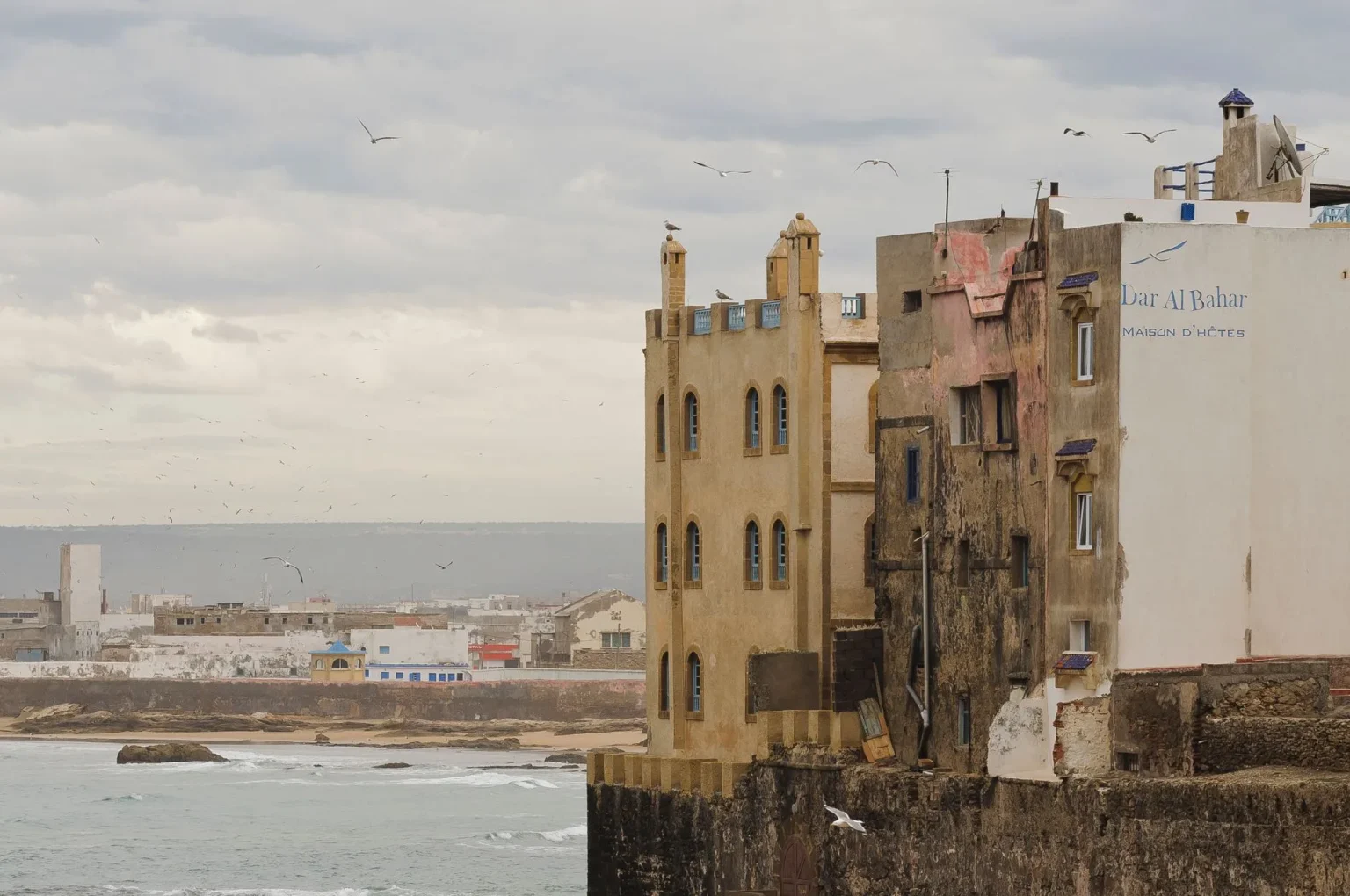

Essaouira is the city people tell you about after they have been to Marrakech. Usually with a slightly embarrassed expression, because they meant to stay two nights and stayed five.
It is a walled Atlantic port of about eighty thousand people, three hours west of Marrakech. It is compact, it is laid out on a grid, nobody follows you down the street, and there is a fishing fleet that comes in every afternoon. After the intensity of the imperial cities it functions as a decompression chamber.
It is also windy. Constantly, reliably windy. That is the trade.
Why it looks different
Essaouira was largely built in the 1760s, which by Moroccan standards makes it new. Sultan Mohammed ben Abdallah wanted a port that could handle European trade and hired a French engineer, Théodore Cornut, to design it.
The result is unique in Morocco: a medina laid out on a rough grid, with straight streets and right angles, inside European-style fortifications built to take cannon. You cannot get properly lost here, which after Fès feels like a holiday in itself.
The town was called Mogador by Europeans for most of its history, traded heavily with Britain and the Atlantic ports, and had a large Jewish community whose quarter — the Mellah — still stands, partly restored. UNESCO listed the medina in 2001.
What to do
The ramparts and the Skala
The Skala de la Ville is the sea wall on the north-west corner, lined with brass cannon, taking the Atlantic full in the face. It is the classic Essaouira view and it is free.
Below it, the Skala du Port guards the harbour. Both are best in the last hour of daylight, when the light comes in low off the water and the spray lifts over the wall.
The fishing port
The working heart of the town, and the thing to see. Blue wooden boats, gulls in numbers that have to be seen, nets being mended, and the afternoon auction when the catch comes in.
At the port entrance, grills are set up where you choose your fish from the ice and it is cooked in front of you within minutes. Sardines, sea bream, sole, squid, whatever came in. Agree the price by weight before it goes on the fire. Done right it is one of the best meals in Morocco and costs very little.
The medina
Small enough to walk in an hour and worth several. Woodwork is the local craft — thuya, a fragrant burl wood from the argan forests inland, turned and inlaid. The workshops are concentrated near the Skala and you can watch them work.
The Mellah, in the north, is the quietest part of the old town and has been partly restored in recent years. The Sidi Mohammed ben Abdallah museum, in a nineteenth-century house, covers the town’s history and its music.
The beach
An enormous crescent of sand running south from the ramparts. Because of the wind it is a sports beach rather than a sunbathing one — kitesurfers, windsurfers, football matches, camels and quad bikes.
Walk south towards Diabat and it empties out. Continue and you reach the dunes at Cap Sim and the half-buried ruins of an old fort. It is a long, good walk, best in the morning before the wind builds.
Watersports
Essaouira is one of the most dependable wind locations in the world. The season runs roughly April to September, when the trade wind blows hardest, and there are schools on the beach for kitesurfing and windsurfing at every level.
For surfing proper, the breaks are south — Sidi Kaouki, 25 km down the coast, and further to the Taghazout coast.
Argan country
The land inland from Essaouira is the heart of the argan forest, and the tree grows nowhere else. Women’s cooperatives along the Marrakech road press the oil and most welcome visitors.
Two products: cosmetic argan oil, cold-pressed and pale, and culinary argan oil, made from roasted kernels, darker and deeply nutty. The culinary one goes into amlou — argan oil, roasted almonds and honey ground to a paste — which is the single best thing to take home from Morocco.
Buy from a cooperative rather than a souk stall if you want to know what you are getting.
Eating
The port grills are the headline. Beyond them:
The town does seafood tagine better than anywhere — fish with tomato, preserved lemon and chermoula, the coriander-and-cumin marinade that defines Moroccan fish cookery.
Seafood pastilla is the local variation on the great dish of Fès: the same tissue-thin warqa pastry, filled with fish and shellfish instead of pigeon, and without the sugar. It is excellent and you will not find it done as well elsewhere.
Around Place Moulay Hassan the prices are for visitors. One street back they are not.
For the wider context see our guide to Moroccan cuisine.
Getting there
From Marrakech — around three hours by road. Supratours and CTM both run scheduled coaches several times a day, and Supratours connects with the train. Grands taxis do the run faster.
From Agadir — about three hours up the coast.
By air — Essaouira-Mogador airport takes a small number of seasonal European flights. Most people come overland.
The medina is pedestrian. Park outside the walls and walk in; it is a short distance, and unlike Fès or Marrakech you can manage a bag yourself.
Where to stay
Inside the medina, in a dar — the smaller, courtyard-less cousin of the riad. Essaouira’s houses are more modest than the Marrakech palaces and priced accordingly.
The choice that matters: sea-facing or courtyard-facing. Sea-facing rooms get the view, the sound and the Atlantic coming through the window frames in winter. Courtyard rooms are warmer and quieter.
There are also beach hotels south of the ramparts, which give you a pool and cost you the medina.
When to come
Essaouira’s weather is the most stable in Morocco and the least extreme. The Atlantic keeps it mild — it rarely gets properly hot and rarely gets cold.
May to September is warm, dry and at its windiest. This is when the town fills, and it is also when the inland cities are unbearable, which is precisely why Moroccans come here in August.
April, October and November are the sweet spot: still pleasant, less wind, fewer people.
Winter is grey, damp and windy, and the town keeps going. Bring layers; the buildings are stone and heating is inconsistent.
The Gnaoua and World Music Festival, usually in June, fills the town completely — hundreds of thousands of people over four days, with Gnaoua musicians whose tradition traces to sub-Saharan Africa. Plan around it in one direction or the other; there is no accidental visit during the festival.
Practical
- The wind is not occasional. Bring something windproof, in any season. Loose hats are lost hats.
- The gulls are numerous and confident, particularly near the port. Do not eat while walking there.
- Cash for the port grills and the souks; cards work in most restaurants.
- The town is relaxed about dress by Moroccan standards, being a beach town with a long foreign presence. It is still Morocco once you leave the beach.
- Thuya wood is the thing to buy. Check the piece is solid rather than veneered chipboard — weight tells you.
How long
Two nights minimum. Three is better and most people who give it three wish they had given it four.
The day trip from Marrakech technically works and misses the point: six hours in a vehicle to spend four hours in a town whose whole quality is that there is no hurry.
Essaouira is where you go when Morocco has worn you out a little. Give it the time to do its job.
