Morocco can be a rewarding destination for women travelling alone, but a useful guide should neither romanticise the experience nor frighten people with anecdotes. The right approach is preparation: understand the local environment, choose accommodation and transport carefully, and keep current official travel advice in view.
As of September 2026, the U.S. Department of State lists Morocco at Level 2, “exercise increased caution”, because of terrorism risk. Current UK travel advice also warns about petty crime in tourist areas, including pickpocketing and bag-snatching, and recommends caution around scams and unofficial guides. These are national-level advisories, not predictions about an individual trip, but they are more useful than sweeping statements that Morocco is simply “safe” or “unsafe”.
What solo women are most likely to notice
The challenge many women report in busy tourist districts is persistent attention: comments, attempts to start conversations, sales pressure and offers of directions. Experiences vary greatly by city, neighbourhood, clothing, time of day and the traveller herself.
The goal is not to spend the trip on guard. It is to reduce unnecessary friction so that normal encounters have room to happen.
Street harassment: practical responses
- Walk with a clear destination rather than stopping for every unsolicited offer.
- A brief “la, shukran” — no, thank you — is enough. You do not owe a long explanation.
- Move into a shop, café or hotel if someone continues following you.
- Do not hand your phone to a stranger offering directions.
- Use a licensed guide if you want an orientation tour of a complex medina.
UK official travel advice specifically warns about bogus guides in historic districts and recommends checking for an official badge and local authorisation.
Clothing
There is no single tourist dress code for Morocco. Marrakech, Casablanca, Tangier and beach resorts include a wide range of clothing. In more conservative neighbourhoods and rural areas, shoulders and knees covered is a practical default because it attracts less attention and respects local norms.
A scarf is useful for sun, dust, cool evenings and visits where you want extra coverage, but women tourists are not generally required to cover their hair.
Choosing accommodation
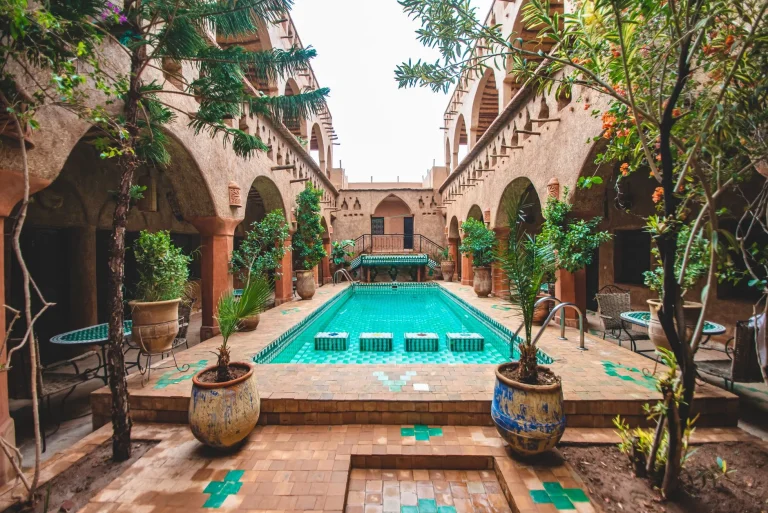
For a first solo trip, location matters more than luxury. Choose a riad or hotel with many recent reviews, a clearly marked entrance and staff available when you expect to arrive.
In medinas, ask the property for the nearest vehicle access point and whether someone can meet you there. Arriving alone after dark while trying to find an unmarked door in a maze of lanes is avoidable stress.
Transport
Use official, licensed taxis and established transport operators. For longer transfers, arrange the driver through the accommodation or a reputable company and confirm the price beforehand.
Official UK guidance for solo travellers recommends reputable taxis, busy train carriages and avoiding hitchhiking. Those principles fit Morocco well.
Trains
Morocco’s rail network connects major cities including Tangier, Rabat, Casablanca, Meknès, Fès and Marrakech. Trains are often one of the easiest ways to travel alone because stations are structured and you avoid negotiating a long-distance road fare.
Keep your valuables with you rather than leaving them unattended at your seat.
Best cities for solo female travel
Marrakech
Marrakech is intense but manageable with preparation. Stay somewhere you can find easily, learn the route between your riad and a major landmark, and expect more sales pressure around the main tourist circuits.
Jemaa el-Fna and the busiest souks remain active into the evening. Late at night, use the same judgement you would in any unfamiliar city: main routes, known transport and no unnecessary wandering in empty lanes.
Fès
Fès el-Bali is architecturally extraordinary and more difficult to navigate than Marrakech. UNESCO describes it as a remarkably preserved historic city, and its dense urban form is part of what makes it special.
A licensed guide for the first half-day can reduce stress and add context. Arrange arrival help through the riad if it is deep inside the medina.
Chefchaouen
Chefchaouen is smaller and easier to learn on foot. The Moroccan National Tourist Office highlights the medina, kasbah and surrounding Rif landscape. Staying overnight lets you experience the town outside the main day-trip hours.
Essaouira
Essaouira is one of the easiest Moroccan cities for independent walking because the medina is compact and the sea gives you constant orientation. The UNESCO-listed old town, port and beach all sit close together.
Desert trips
For Merzouga, a reputable small-group or private operator removes several logistical problems at once: transport, meeting point, camp and return journey. Confirm the operator, vehicle, accommodation and inclusions before paying.
Safety, money and emergencies
Petty crime and money
Keep your passport secure, carry only the cash you need for the day and use ATMs in well-trafficked locations. Bag-snatching and pickpocketing are more realistic everyday risks than dramatic crime scenarios.
Dating apps and new acquaintances
Meet new people in public places, control your own transport and do not give strangers access to your passport, bank card or accommodation room. These are ordinary solo-travel rules, but they become more important when you have no companion checking in on you.
Emergency planning
Current UK travel advice lists Moroccan emergency numbers including police 190, gendarmerie 177 and ambulance/fire 150. Save the numbers, your accommodation address and your insurer details before you need them.
Leave your itinerary with someone at home and agree on a check-in rhythm. Official solo-travel guidance also recommends keeping copies of important documents and having access to emergency funds.
Travel insurance
Insurance should cover the activities you actually plan: trekking, quad biking, surfing or other adventure travel may need specific coverage. Do not assume a basic policy includes everything.
The positive side
Solo travel creates opportunities that couples and groups often miss. Conversations in riads, cooking classes, cooperatives and neighbourhood cafés happen differently when you are alone. Moroccan hospitality can be generous and personal; the aim of preparation is to make space for those experiences while reducing avoidable problems.
Bottom line
Morocco is not a destination to approach with either fear or naivety. Check current government travel advice, choose transport and accommodation deliberately, use licensed guides where they add value and trust your own judgement. With those basics in place, solo travel can be one of the most rewarding ways to see the country.
Practical systems that make solo travel easier
Phone, maps and communication
Download offline maps before walking into a medina and save your accommodation as a pinned location. A screenshot of the riad name, address and nearest vehicle-access point is useful when mobile data becomes unreliable.
Keep the property’s WhatsApp or phone number available offline. In Fès or Marrakech, asking the riad to send a staff member to a known gate is often easier than trying to solve the final five minutes alone.
Night arrivals
If a flight, train or bus arrives late, arrange the final transfer in advance. This is not because every medina becomes dangerous after dark; it is because navigation, closed shops and reduced foot traffic make the first arrival unnecessarily difficult.
A known driver plus a confirmed meeting point removes the most avoidable stress from a solo trip.
Language helps even when you are not fluent
French is widely useful in travel and service contexts, while Darija is the everyday Moroccan Arabic spoken across much of the country. A few words — greeting, thank you, no thank you, how much — reduce the feeling that every interaction must happen through English.
Do not pretend fluency. Clear, simple communication is better than memorising elaborate phrases you cannot understand in reply.
Build a check-in system that is not intrusive
Share your basic route with one trusted person and agree on a sensible check-in rhythm. Daily can be useful on remote sections; every hour is unnecessary and turns a holiday into surveillance.
Keep digital copies of passport, insurance and major bookings in secure cloud storage as well as offline. The goal is resilience if a phone or bag disappears.
For city-by-city comparison, see our guide to Morocco’s best cities for solo travellers.
Leave a comment