


Most of Morocco’s 3,500 km of coastline has nothing on it. The development is concentrated in perhaps a dozen places, and between them are river mouths, lagoons, cliff coves and long empty strands that take a little effort to reach and are effectively yours when you get there.
This is a guide to those. For the main beaches and which coast suits which holiday, see our guide to Morocco’s best beaches.
Read this first
Empty beaches in Morocco are empty for reasons, and one of them is the water.
The Atlantic here is fed by the Canary current. It is cold — roughly 16–19°C in winter, rarely above 22°C in late summer — and it carries strong, consistent rip currents. There are no lifeguards anywhere in this guide. None.
If you are pulled out, swim parallel to the shore until you are clear of the pull, then come in. Do not swim against it. On a deserted beach, do not swim alone.
The Mediterranean coves in the north are a different proposition — warmer, calmer, and safe to swim from June to October.
The Atlantic coves
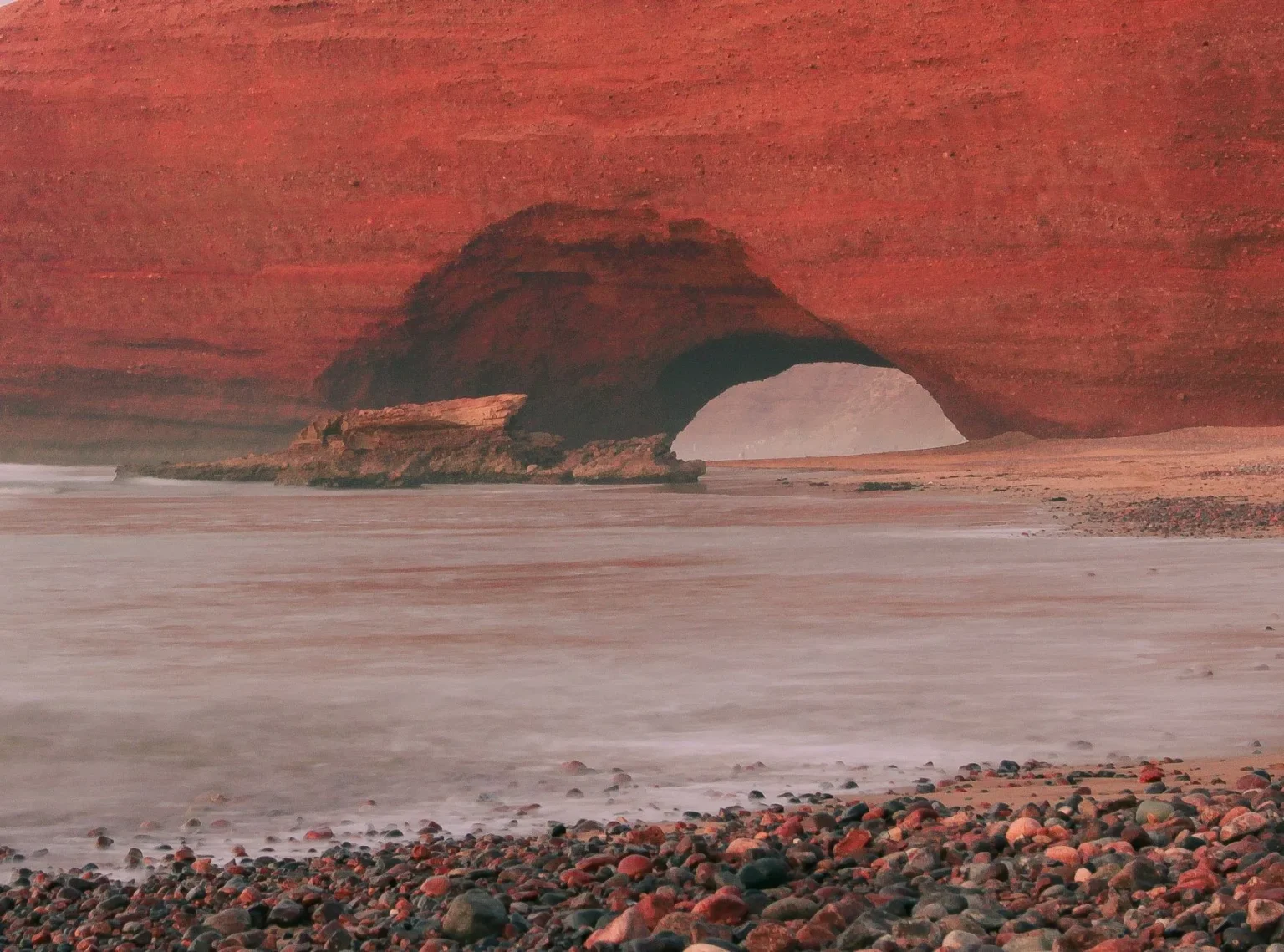
Legzira
South of Sidi Ifni, where red sandstone cliffs meet a wide beach and the Atlantic has cut arches through the rock.
Be clear about the current state: one of the two famous arches collapsed in September 2016. Images showing both are old. The remaining arch is standing and the beach at sunset — the rock goes from rust to deep red as the light drops — is still one of the most striking places on the Moroccan coast.
The sandstone is actively eroding. Do not walk directly under the arch.
Facilities are a handful of small guesthouses and cafés at the northern end. Reachable by grand taxi from Sidi Ifni.
Sidi Kaouki
Twenty-five kilometres south of Essaouira: a long, wild, wind-scoured strand with a marabout shrine at one end, horses and camels on the sand, and very little else.
Serious wind almost every day, which is why the surfers and kitesurfers are there and the sunbathers are not. A few guesthouses, one or two cafés.
Cap Sim and the Diabat dunes
Between Essaouira and Sidi Kaouki, reachable on foot or on horseback along the beach from Diabat. Sand dunes, the ruins of an old fort half-buried in them, and an empty shoreline. Walk out from Essaouira in the morning and you will meet almost nobody.
Imsouane
A fishing village between Essaouira and Agadir, set around a bay with one of the longest right-hand waves in Africa — a ride measured in hundreds of metres, which is why surfers make the detour.
Two beaches: the bay, sheltered and gentle, and the cathedral beach, exposed. The village has grown but remains small.
Plage Blanche
South of Guelmim, a genuinely enormous stretch of pale sand running for tens of kilometres with essentially nothing on it. Remote, hard to reach without a vehicle, and worth it if you are heading south anyway.
The Dakhla lagoon
Far south, a 40 km lagoon enclosed by a narrow peninsula. Flat, shallow, turquoise water inside; open ocean outside. Wind almost every day of the year, which has made it one of the world’s best kitesurfing locations.
Not hidden any more — there are camps and direct flights — but the scale means you can still find empty water. The oyster farms and the desert-meets-ocean landscape are worth a few days even without a kite.
The lagoons
Oualidia
The one calm swimming spot on the Atlantic coast, and for many visitors the best beach in Morocco.
A crescent lagoon between El Jadida and Safi, shielded from the ocean by a rock barrier with a narrow entrance. Inside: shallow, still, comparatively warm water that is safe for children — something the open Atlantic offers nowhere.
It is also the country’s oyster capital. The beds are farmed in the lagoon and shucked at the water’s edge. The village is small and fills in summer.
Moulay Bousselham and the Merja Zerga
North of Kenitra, where a lagoon and wetland meet the sea. This is a bird site above all — a Ramsar wetland, with flamingos, spoonbills and large numbers of migrating waders in winter. Local boatmen run trips out onto the lagoon.
The ocean beach beside it is long and largely empty outside August.
Souss-Massa
South of Agadir, a national park at the mouth of the Massa river. Dunes, river mouth, and one of the last wild colonies of the northern bald ibis — a bird that is critically endangered and that you can reliably see here.
The Mediterranean coves
The north is a different sea: warm, clear, calm, and almost unknown to foreign visitors.
Al Hoceima national park
The best of it. A stretch of Rif coastline east of the town, with small coves cut into limestone cliffs, reached on foot down steep paths or by boat from Al Hoceima harbour.
Cala Iris is the best known, with a small island offshore. Around it are half a dozen smaller inlets with no road access at all. The water is clear enough for snorkelling and genuinely swimmable from June to October.
Hiring a small boat for a few hours from the harbour is the way to see it, and is not expensive if you can find others to share.
Cap des Trois Fourches
A long, thin cape reaching north from near Melilla, with a lighthouse at the end and a series of small beaches down both sides. The road is narrow and slow. Almost nobody goes.
Oued Laou and the Tetouan coast
South-east of Tetouan, where the Rif comes down to the Mediterranean and river valleys open onto small beaches. Busy with Moroccan families in August, empty the rest of the year.
Practical
- Getting there. Most of these need a grand taxi charter or your own vehicle. Agree the fare before setting off, and agree the return — on an empty beach there is nothing to flag down.
- Take everything with you. Water above all. Most of these places have no shop, and several have no shade.
- Tides. The Atlantic range is significant. A cove reachable on foot at low water can be cut off at high water. Check before you walk round a headland.
- Dress. On remote Atlantic beaches nobody is watching. Near villages and on municipal beaches, where Moroccan families gather, most local women swim covered. Reading the beach costs nothing.
- Leave nothing. There is no collection on these beaches. What you carry in, you carry out.
- Camping. Wild camping is tolerated in many coastal spots and regulated in others, particularly inside national parks. Ask locally rather than assuming.
If you only do one
Oualidia, if you want to swim — it is the only Atlantic water in Morocco that is genuinely comfortable, and the oysters are worth the trip on their own.
Cala Iris and the Al Hoceima coves, if you want the clear warm water and the sense of having found something. It is the least visited good coastline in the country, and that will not last indefinitely.
Legzira, if you want the photograph and a long empty beach at the end of the day — as long as you go knowing there is one arch now, not two.
