

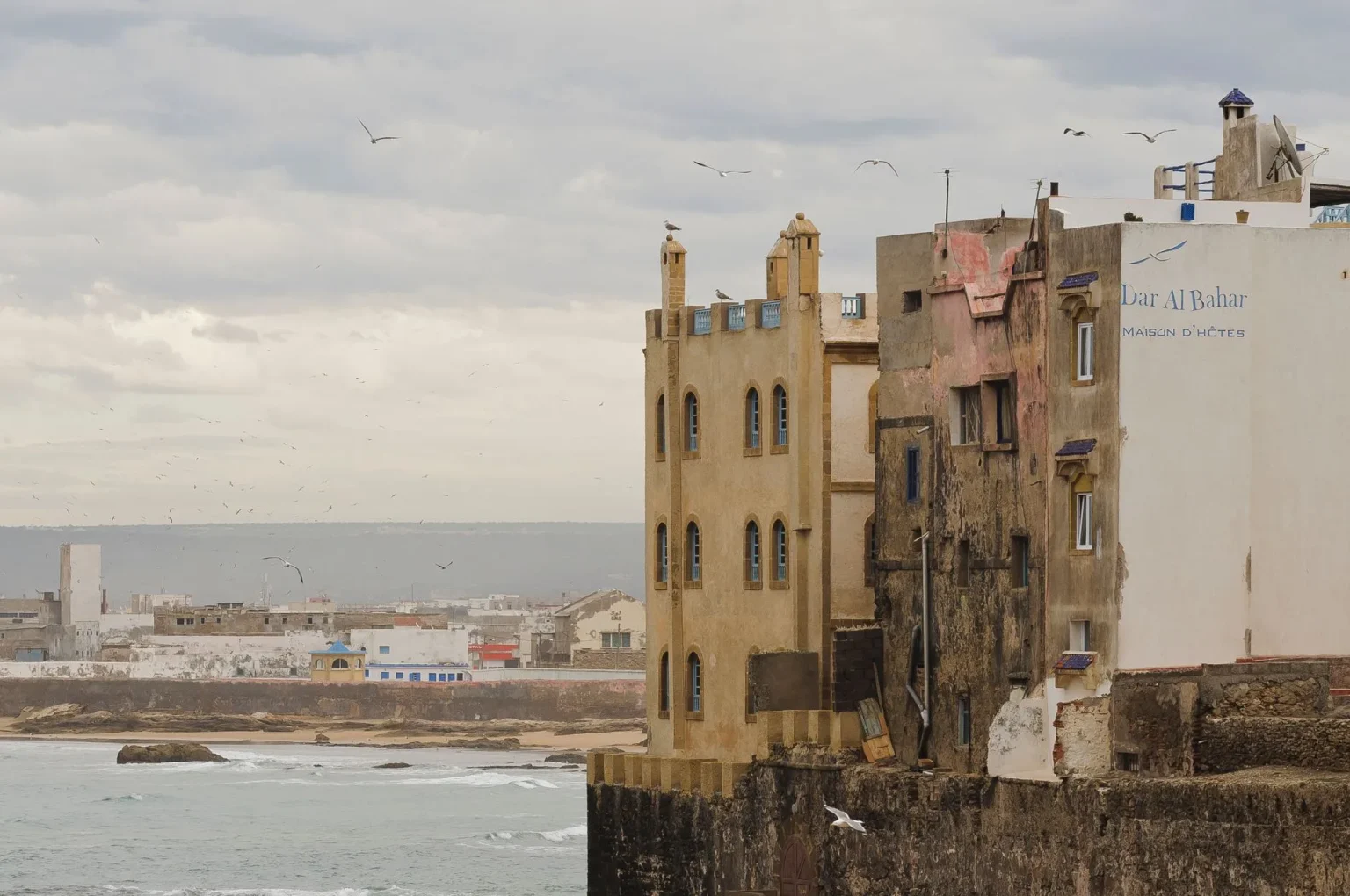

Sailing Morocco from Essaouira means working with a coast that almost never goes flat. The prevailing wind here blows from the north-northwest, and offshore model data covering two decades shows the sea is glassy on roughly one day in an average August. That single number should decide your boat, your route and your month — before you look at any price.
- Why do sailors choose Essaouira over the rest of Morocco’s coast?
- What do the wind numbers actually say?
- Essaouira sailing scorecard
- Which boat should you actually book?
- What does the standard Essaouira circuit look like?
- Can you land on Mogador Island?
- What should you bring on the water?
- Mistakes almost every first-timer makes
- What changed for sailing Morocco in 2026?
- Sailing Morocco FAQ
- Is Essaouira good for sailing?
- Can you visit Mogador Island?
- When is the best month for sailing Morocco’s Atlantic coast?
- How cold is the sea at Essaouira?
- Can beginners sail in Essaouira?
- Are dolphin sightings guaranteed?
- How far is Mogador Island from Essaouira?
- Do I need to book in advance?
- Sources
Why do sailors choose Essaouira over the rest of Morocco’s coast?
Essaouira is the only Moroccan Atlantic port where a fortified medina, a working fishing harbour and a protected offshore archipelago sit within 2 km of each other. That geography produces a short, visually dense sailing circuit that does not require offshore passage-making, and it explains why the city supports both commercial fishing and a permanent watersports economy.
The bay is sheltered by the Mogador archipelago itself. Morocco’s national tourist office credits those islands with breaking the Atlantic swell before it reaches the town beach — which is precisely why a city this exposed has usable water at all.
The history is unusually deep for a sailing stop. A Phoenician settlement stood on the island’s landward side in the late 7th century BC. The Romans harvested murex shellfish here for imperial purple dye under King Juba II — the origin of the name Îles Purpuraires. And Sir Francis Drake spent Christmas 1577 anchored off these islands.
“Verie ugly fish.”
What do the wind numbers actually say?
Essaouira’s wind is not a marketing adjective — it is measurable, and the difference between winter and summer is dramatic. Wave-model archives running at three-hour intervals since 2006, sampled at the nearest node 26 km offshore, give a hard read on how often the water is workable for a relaxed sail.
| Metric (model average) | January | August |
|---|---|---|
| Sea glassy (near-calm) | 15% — about 5 days | 1.8% — about 1 day |
| Wind blowing offshore | 26% — about 8 days | 2% — about 1 day |
| Days above 40 km/h | 2 days | 5 days |
| Prevailing direction | NW | NNW |
Read that table backwards and the planning rule writes itself. If you want a comfortable circuit with a camera in your hand, January gives you eight times more calm-water probability than August. If you want the boat to heel and the sails to load, August delivers on five days out of thirty-one.
Essaouira sailing scorecard
Which boat should you actually book?
The choice is between a sailboat that uses the wind and a motorboat that fights it — and in Essaouira that decision changes the entire day. A sailing yacht heels and takes the swell diagonally; a small motorboat slams into it. On a 20-knot NNW afternoon those are two completely different experiences of the same bay.
Ask one question that separates serious operators from resellers: what sea state do you refuse to sail in? An operator who cannot answer in metres and knots is selling photos, not seamanship.
What does the standard Essaouira circuit look like?
The classic half-day route is a 4–6 km loop: harbour exit, ramparts from seaward, the Mogador channel, then a windward return. It rarely exceeds two hours underway, and every leg has a specific reason to exist.
Port de pêche — departure ▸
Blue-hulled trawlers, ice trucks, gulls. Keep bags out of working areas and stay seated until the skipper clears the harbour wall.
Skala de la Ville from seaward ▸
The 18th-century sea bastion and its row of bronze cannon. This is the shot the ramparts cannot give you from land — the wall reads as a defensive line, not a promenade.
Mogador channel ▸
The 30-hectare main island with its ruined fortress, prison and minaret. You circle; you do not land. Binoculars earn their weight here.
Windward beat home
Against a NNW breeze this is the longest leg. Budget 40 minutes and do not book a Marrakech transfer for the hour you land.
Can you land on Mogador Island?
No. Landing on the Îles Purpuraires requires official authorisation that is rarely granted, and boat excursions are permitted only around the archipelago. The islands are a Ramsar-listed wetland — “Archipel et dunes d’Essawira” — and the restriction protects a bird population that exists nowhere else in the same form.
Mogador holds the only breeding colony of Eleonora’s falcon outside the Mediterranean. The birds arrive around May, nest through the summer, then migrate to Madagascar — which makes late summer through October the peak window for seeing them hunt over the water.
| Mogador archipelago | Figure |
|---|---|
| Coordinates | 31°29′42″N, 9°47′07″W |
| Main island area | ≈ 30 hectares |
| Distance from shore | 1.2–1.5 km |
| Yellow-legged gull density | ≈ 217 birds per hectare |
| Gull population growth | +3.58% a year since 1985 |
| Separated from mainland | ≈ 6,000 years ago |
That gull density — the highest recorded in west-central Morocco — is why the archipelago sounds the way it does long before you can see individual birds. The colony grew from roughly 4,260 individuals in 1985 to more than 15,000 by 2019.
What should you bring on the water?
Pack for 17 °C water and 20-knot wind even when the medina is warm and still. The Canary Current pushes cold upwelling along this coast, holding sea temperature between 16 and 22 °C even at the height of summer — divers here use 5 mm suits in August.
☑ Closed non-slip shoes
☑ Sunglasses with a retainer cord
☑ SPF 50 (wind masks the burn)
☑ Waterproof phone pouch
☑ Binoculars for the falcon colony
☑ Seasickness tablet taken 60 minutes before boarding
☑ Offline screenshot of the meeting point
Mistakes almost every first-timer makes
The biggest error is booking Essaouira as if it were a Mediterranean bay with better light. It is an exposed Atlantic coast with a fishing economy attached, and the sea sets the schedule.
Second: chasing distance. The value here is concentrated in the first 1.5 km — ramparts, channel, archipelago. Two extra hours offshore adds swell, not scenery.
Third: scheduling a non-refundable Marrakech transfer for the same afternoon. The road takes about three hours; a delayed return can cost you the whole leg. Plan Essaouira as an overnight stop rather than a day trip built around a boat.
What changed for sailing Morocco in 2026?
The coastline has not changed; the product mix has. Private charter listings around Essaouira have multiplied, and structured multi-day sailing programmes now cluster further south around Agadir. The practical consequence is that “boat tour” and “sailing trip” are now sold under the same headline at very different prices.
Verify the vessel type, the crew qualification and the cancellation clause before the price. See our other Morocco tours and experiences and route-by-route itineraries to build the rest of the trip around the coast.
Sailing Morocco FAQ
Is Essaouira good for sailing?
Yes, if you want wind. The prevailing NNW breeze is close to constant in summer, with winds above 40 km/h on roughly five days in an average August. For calm-water sightseeing, January is the stronger month: near-glassy conditions occur about 15% of the time against 1.8% in August.
Can you visit Mogador Island?
You can sail around it, not onto it. Landing requires official authorisation that is rarely granted, because the archipelago is a protected nature reserve holding the only non-Mediterranean breeding colony of Eleonora’s falcon. Licensed operators run boat and diving excursions in the surrounding water.
When is the best month for sailing Morocco’s Atlantic coast?
December to March for calm water and photography; June to September for sailing performance. January averages about five near-glassy days and eight offshore-wind days, while August averages one of each. Choose the month to match the experience you actually want.
How cold is the sea at Essaouira?
Between 16 and 22 °C year-round. Cold upwelling from the Canary Current keeps the Atlantic here well below Mediterranean summer temperatures, which is why local divers wear 5 mm wetsuits even in August. On deck it means wind chill is real regardless of the air temperature ashore.
Can beginners sail in Essaouira?
Yes, on a skipper-led boat in a calm forecast window. State your experience level when booking and confirm whether you will be a passenger or handling sheets. Beginners should avoid summer afternoons, when the thermal wind is strongest and the returning leg becomes a windward beat.
Are dolphin sightings guaranteed?
No. Dolphins in the Essaouira bay are wild and unpredictable, and no responsible operator sells them as a certainty. Seabirds are the reliable wildlife here — the archipelago carries roughly 217 gulls per hectare, the highest density recorded in west-central Morocco.
How far is Mogador Island from Essaouira?
Between 1.2 and 1.5 kilometres offshore, opposite the port. The main island covers about 30 hectares and separated from the mainland roughly 6,000 years ago. From the harbour, a boat reaches the channel in well under twenty minutes in normal conditions.
Do I need to book in advance?
Book the boat in advance but never the day. Confirm the rescheduling policy in writing before paying, keep the following morning free as a fallback slot, and re-check the marine forecast the evening before rather than trusting the conditions predicted at booking.
Sources
Wind and calm-water statistics: Essaouira wind statistics, surf-forecast.com (NWW3 model archive, 3-hour intervals since 2006). Island status and ecology: Mogador Island; Ramsar site “Archipel et dunes d’Essawira”. Destination and access: Moroccan National Tourist Office; Lonely Planet — Île de Mogador. History: Rough Guides.
