
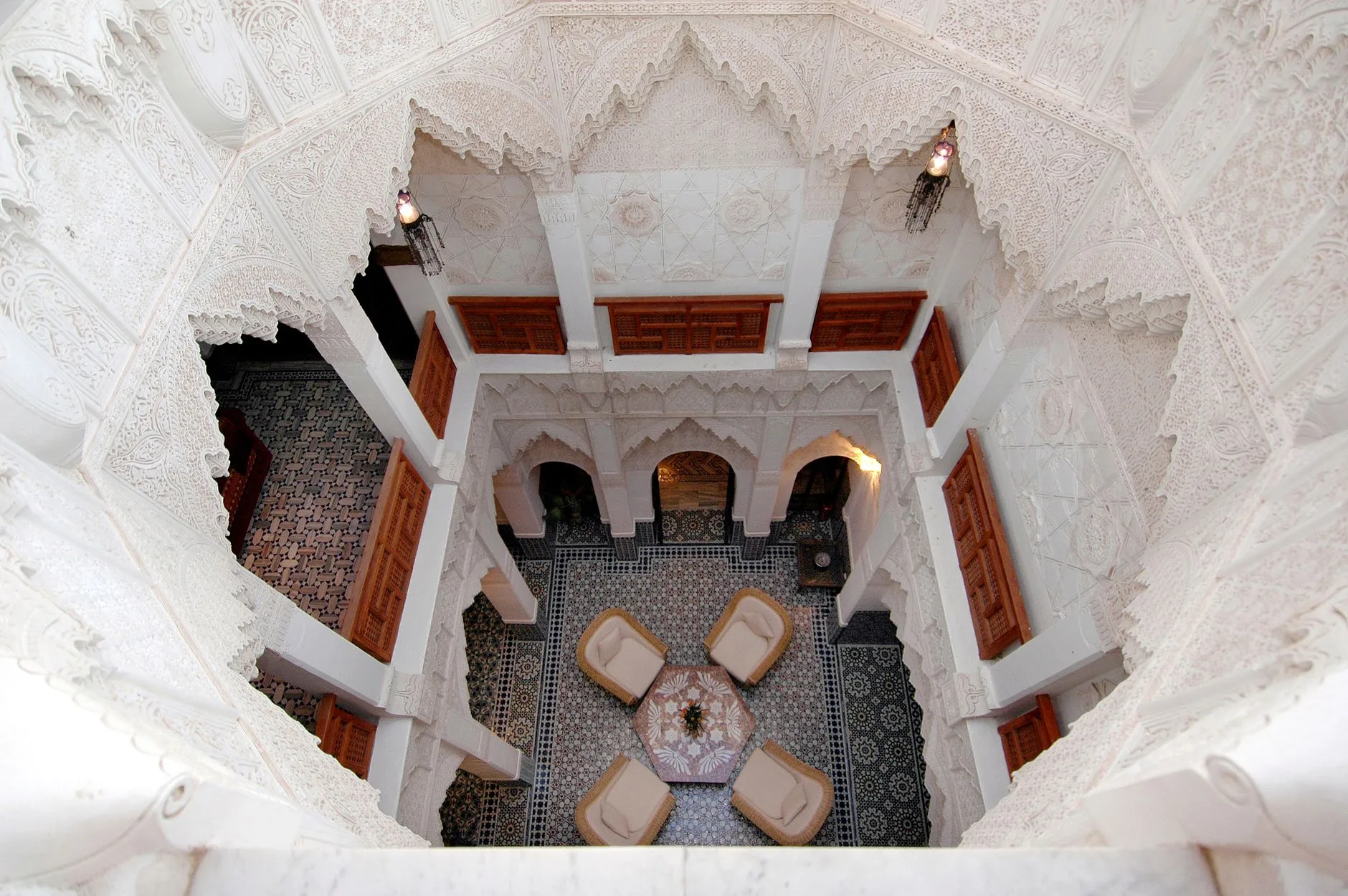
Morocco’s architectural heritage — Marinid medersas, Saadian palaces, Amazigh kasbahs, courtyard houses and grand hotels — provides the raw material for some of the country’s most memorable stays. In the best properties, the building is not a backdrop. It changes how the stay feels: where light enters, how rooms open onto a courtyard, how thick earthen walls hold temperature, and how terraces connect the house to the city or landscape.
| Property | Building | Setting |
|---|---|---|
| Kasbah Tamadot | Kasbah | High Atlas foothills |
| Dar Ahlam | 19th-century kasbah | Skoura oasis |
| Palais Amani | Historic palace house | Fès el-Bali |
| Scarabeo Camp | Stone-and-canvas camp | Agafay |
| Riad Joya | Contemporary riad interpretation | Marrakech medina |
The photographs below are illustrative images from the Maroc Horizons archive and are not presented as photographs of the named properties.
Kasbah Tamadot, High Atlas
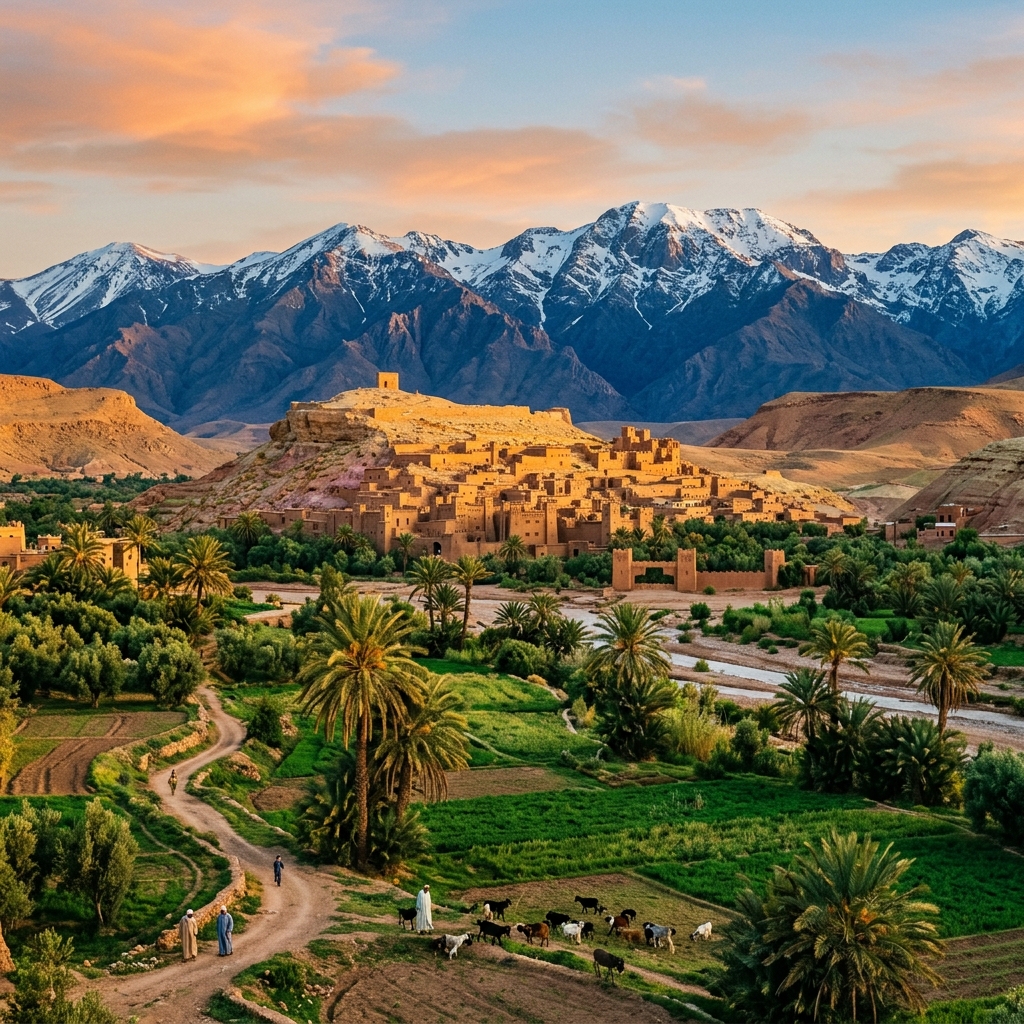
Kasbah Tamadot sits in the foothills of the High Atlas near Marrakech. The appeal is the combination of mountain landscape and architecture: thick walls, courtyards, terraces and Moroccan craft details create a stay that feels connected to place rather than inserted into it.
For travellers, the practical question is whether to use an Atlas property as a one-night escape from Marrakech or as a base for several days. The second option makes more sense if hiking, village visits and slower mornings are part of the trip.
Dar Ahlam, Skoura
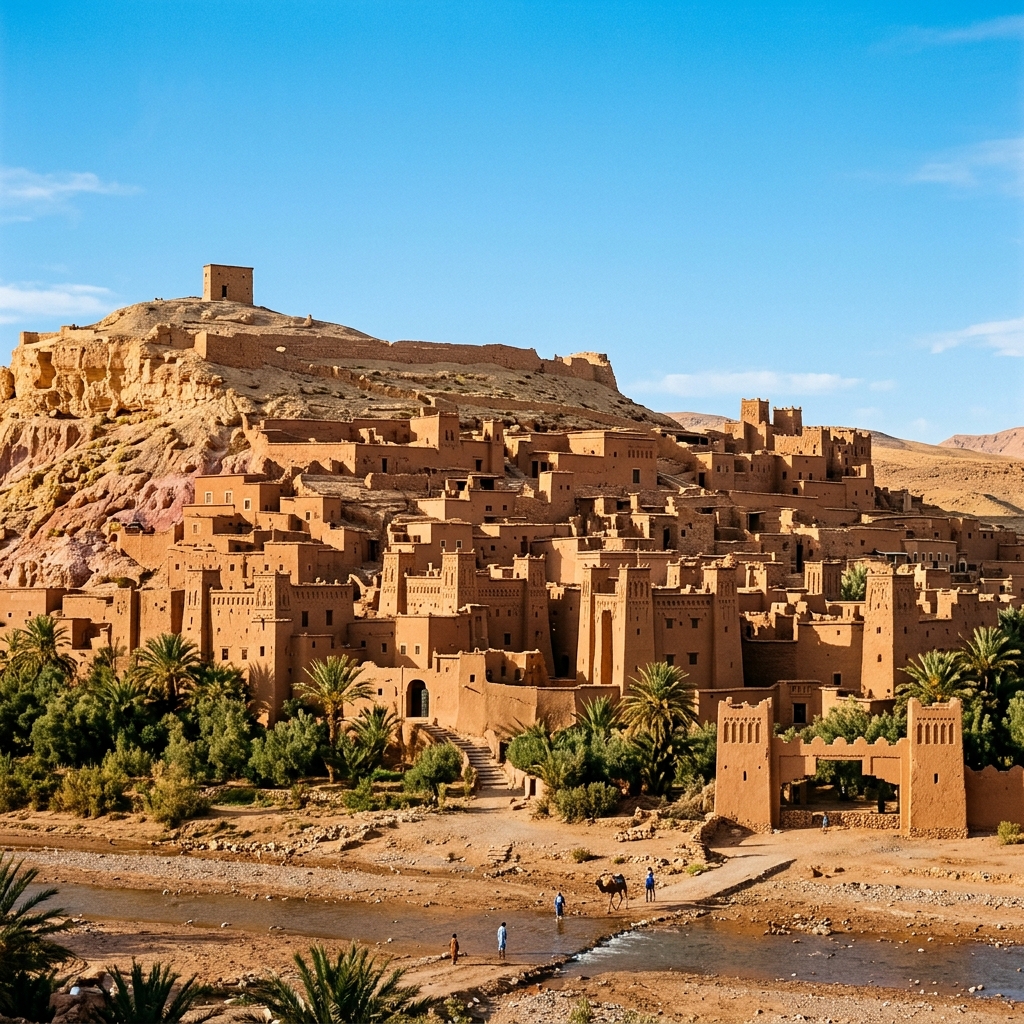
Dar Ahlam occupies a restored kasbah in the Skoura oasis, one of the classic palm-grove landscapes of southern Morocco. Skoura is a natural stop between Ouarzazate and the valleys leading toward the desert, but it rewards travellers who stay rather than simply drive through.
The architectural interest is the relationship between earthen construction and oasis climate: shaded spaces, thick walls and courtyards make sense here in a way that a conventional resort building would not.
Palais Amani, Fès
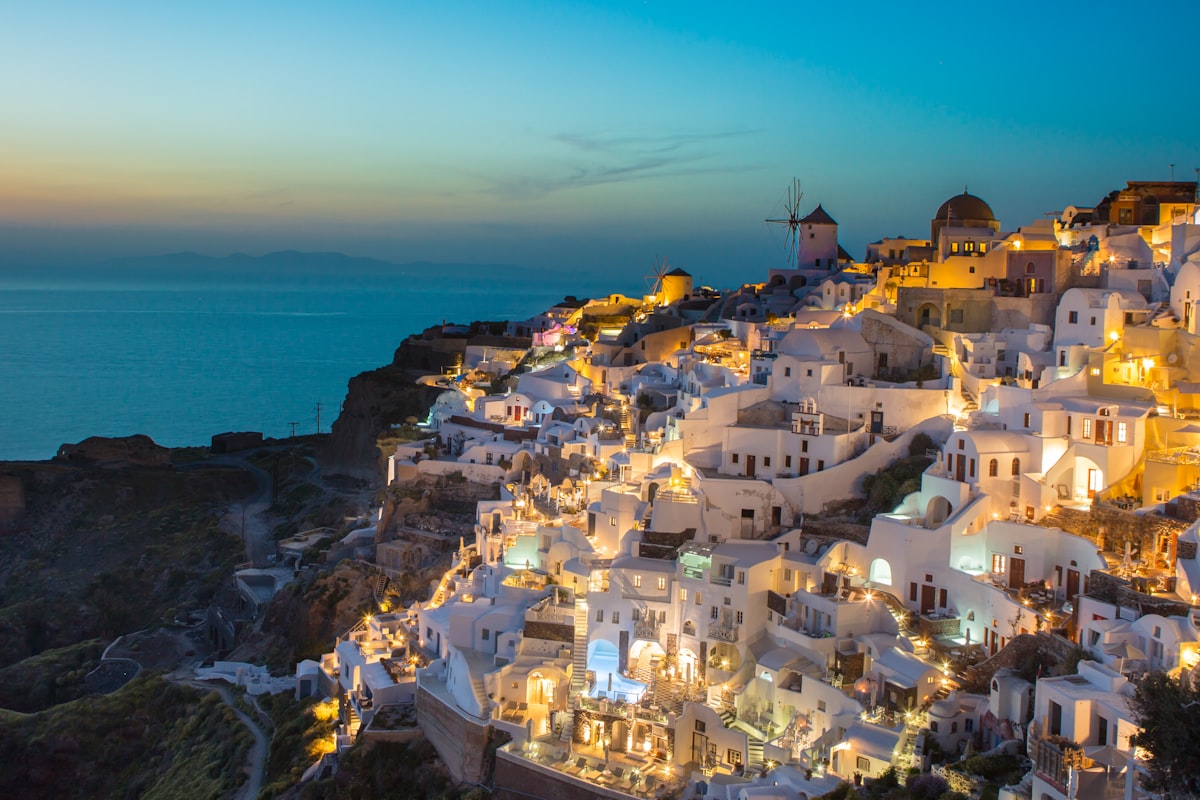
Palais Amani is in Fès el-Bali, where the building fabric is part of one of Morocco’s most important historic urban landscapes. UNESCO describes the Medina of Fez as a remarkably well-preserved historic city whose architecture reflects more than ten centuries of local skill and outside influence.
That matters when choosing accommodation. A palace house inside the medina offers atmosphere and craftsmanship, but also stairs, limited vehicle access and courtyard acoustics. The building’s character and its inconveniences are the same thing.
Scarabeo Camp, Agafay
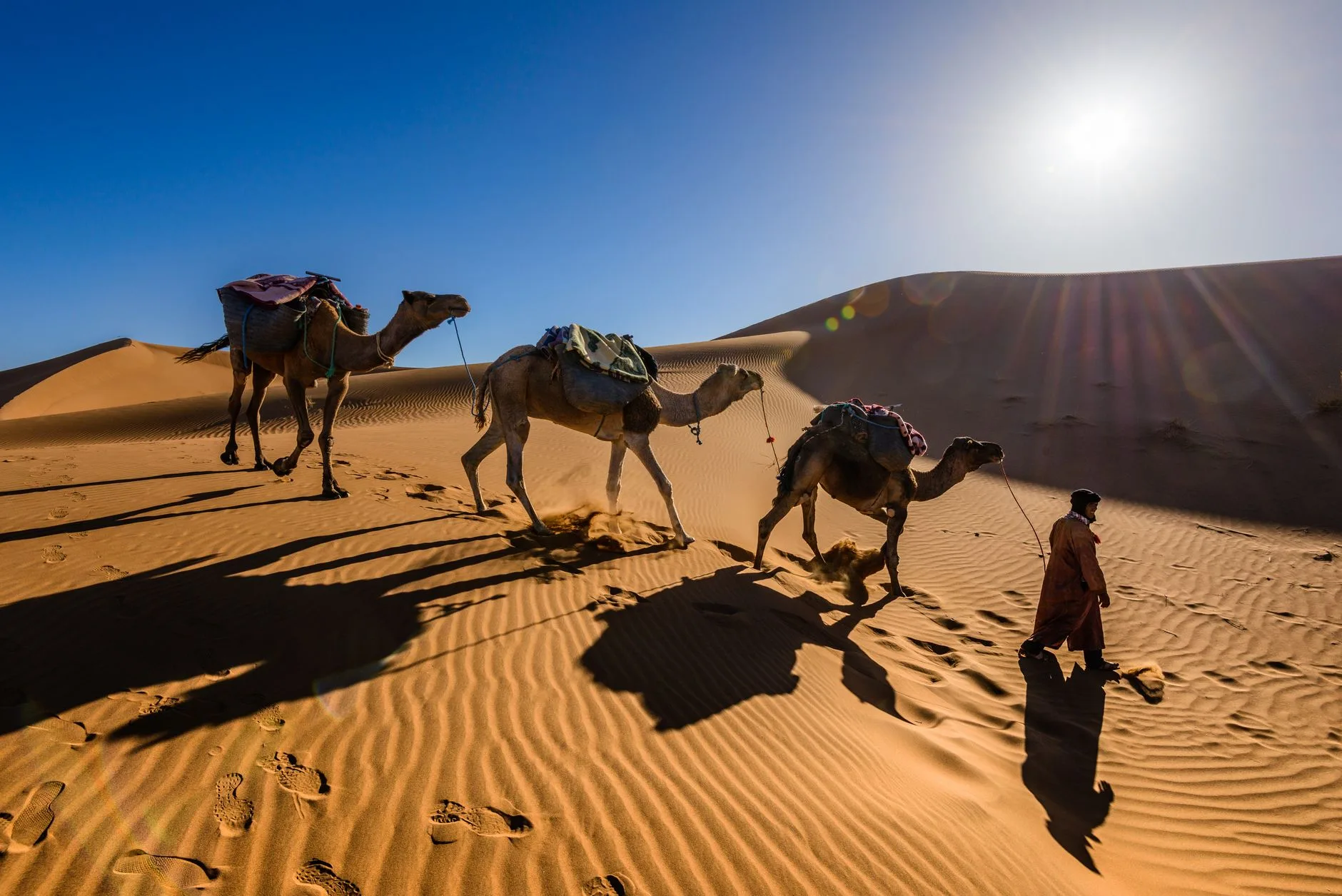
Agafay is a rocky desert landscape outside Marrakech rather than a field of Sahara dunes. Camps here work because they use the emptiness, horizon and Atlas views as part of the architecture. Tents, stone walls, terraces and low-profile structures are more important than decorative “desert” styling.
Agafay is useful for travellers who want one night under open skies without the long road to Merzouga. It should not be sold as the Sahara: the landscapes are different, and that difference is part of the point.
Riad Joya, Marrakech
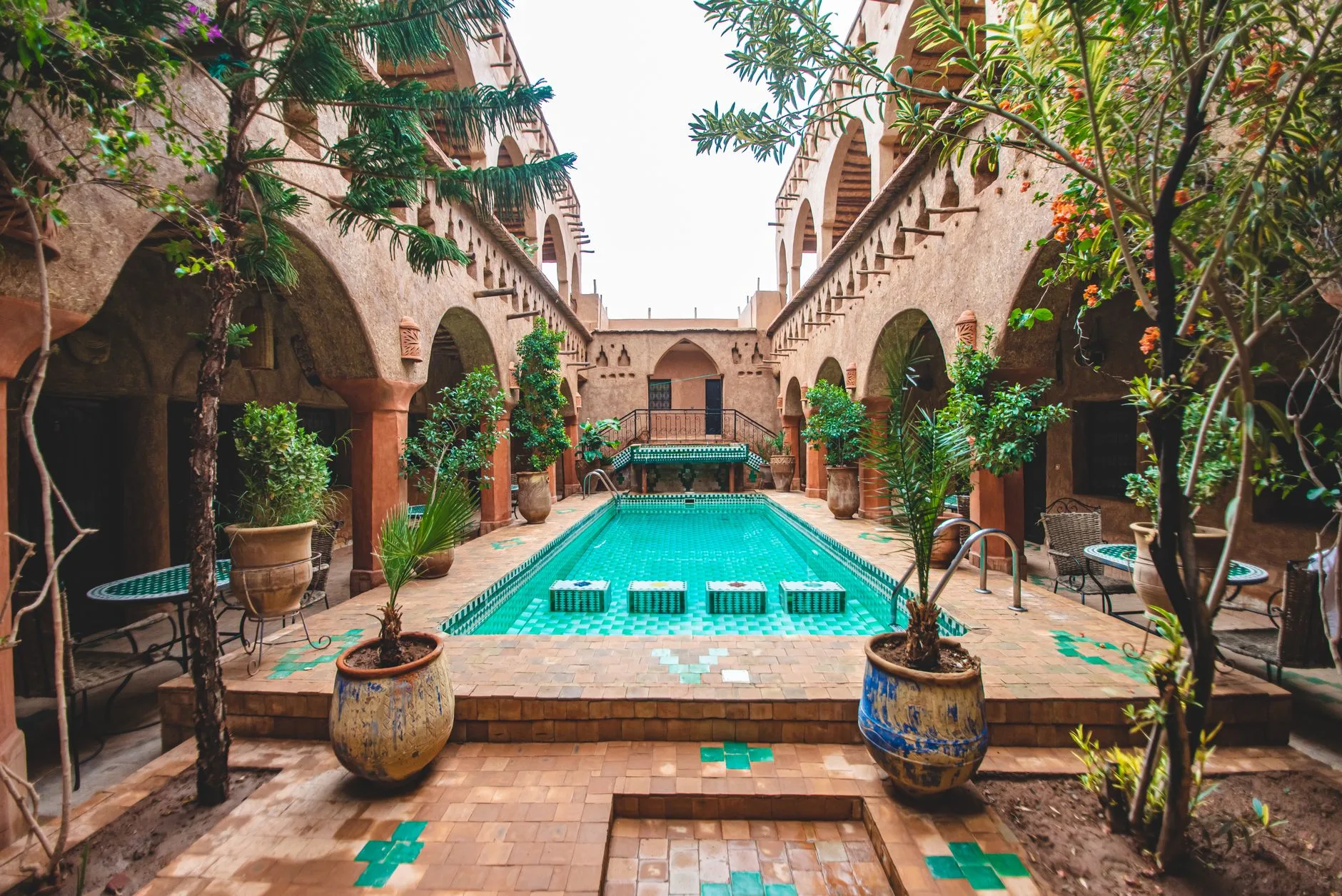
A riad is an inward-looking urban house organised around a courtyard or garden. Marrakech has turned the form into one of its signature accommodation types. The best contemporary interpretations respect the proportions, materials and quiet of the original typology without pretending every detail is ancient.
The Moroccan National Tourist Office itself presents riads and courtyard architecture as part of the identity of Marrakech. For travellers, this is one of the clearest cases where architecture changes the stay: street outside, courtyard inside, roof above.
Kasbah, riad, palace or camp: what is the difference?
Kasbah
In travel language, “kasbah” is used loosely, but in southern Morocco it usually refers to fortified or defensive earthen architecture associated with powerful families, trade routes and oasis settlements. Thick walls and towers are visual signatures.
Riad
A riad is an urban courtyard house built inward for privacy, shade and family life. The central space organises the rooms. In a hotel conversion, that creates beauty but also carries sound vertically through the building.
Palace house
Fès and Marrakech contain large historic houses with elaborate zellige, carved plaster and cedar. When converted into hotels, their scale and craft can feel more monumental than a small riad.
Desert camp
A camp is landscape architecture. Its success depends less on ornament than on placement, privacy, light and how much the built environment interferes with the horizon.
How to choose an architecture-led stay
- Ask what is original. “Historic” can mean anything from a genuinely old structure to a new building using traditional decoration.
- Ask which room. In courtyard houses, floor and orientation matter more than the hotel’s overall reputation.
- Check access. Medina hotels may require walking from the nearest vehicle point.
- Check heating and cooling. Thick historic walls behave very differently by season.
- Do not confuse Agafay with the Sahara. Both are worthwhile, but they are not the same landscape.
The wider architectural context
Morocco’s historic cities are not isolated monuments. UNESCO lists nine Moroccan cultural World Heritage properties, including the medinas of Fès, Marrakech, Essaouira and Tétouan, the historic city of Meknès, Rabat, Volubilis, Mazagan and the Ksar of Aït-Ben-Haddou. Staying inside or near these urban fabrics gives architectural travel a depth that a stand-alone hotel cannot reproduce.
That is the real reason to choose an architecture-led stay in Morocco. The best properties are not simply attractive rooms. They help explain the country’s climates, materials, privacy traditions, craft and relationship between house, street and landscape.
Materials worth learning to recognise
Architecture becomes much more interesting once the materials have names. Zellige is hand-cut glazed tile assembled into geometric patterns. Tadelakt is polished lime plaster used on walls, bathrooms and hammams. Cedar appears in doors, ceilings and carved screens, especially in historic urban houses. In the south, rammed earth and mud brick connect buildings directly to the colour and climate of the landscape.
These materials are not interchangeable decoration. They belong to different regions, building types and craft traditions. A hotel that explains what was restored, what was reproduced and what was newly built is usually more interesting than one that simply labels every carved surface “traditional”.
How architecture changes comfort
Historic architecture comes with practical consequences. Courtyards bring light and air but also carry sound. Thick walls can keep rooms cool in summer and surprisingly cold in winter. Upper floors may have better light but require steep stairs. A remote kasbah can offer extraordinary quiet while adding transfer time to every excursion.
This is why the best architecture-led stay is not always the most photogenic one. Match the building to the trip: medina house for urban immersion, Atlas or oasis kasbah for landscape, desert camp for horizon and night sky.
Before you book
- Ask whether the building is historic, reconstructed or newly built in a traditional style.
- Ask for photographs of the exact room category, not only the courtyard and roof.
- Check heating, cooling and stair access.
- Confirm the vehicle drop-off point for medina properties.
- For remote stays, confirm transfer time before building an itinerary around them.
For the practical side of courtyard accommodation, see our guide to choosing a riad in Morocco. For a broader comparison of high-end stays, see our guide to luxury hotels in the imperial cities.

Leave a comment