

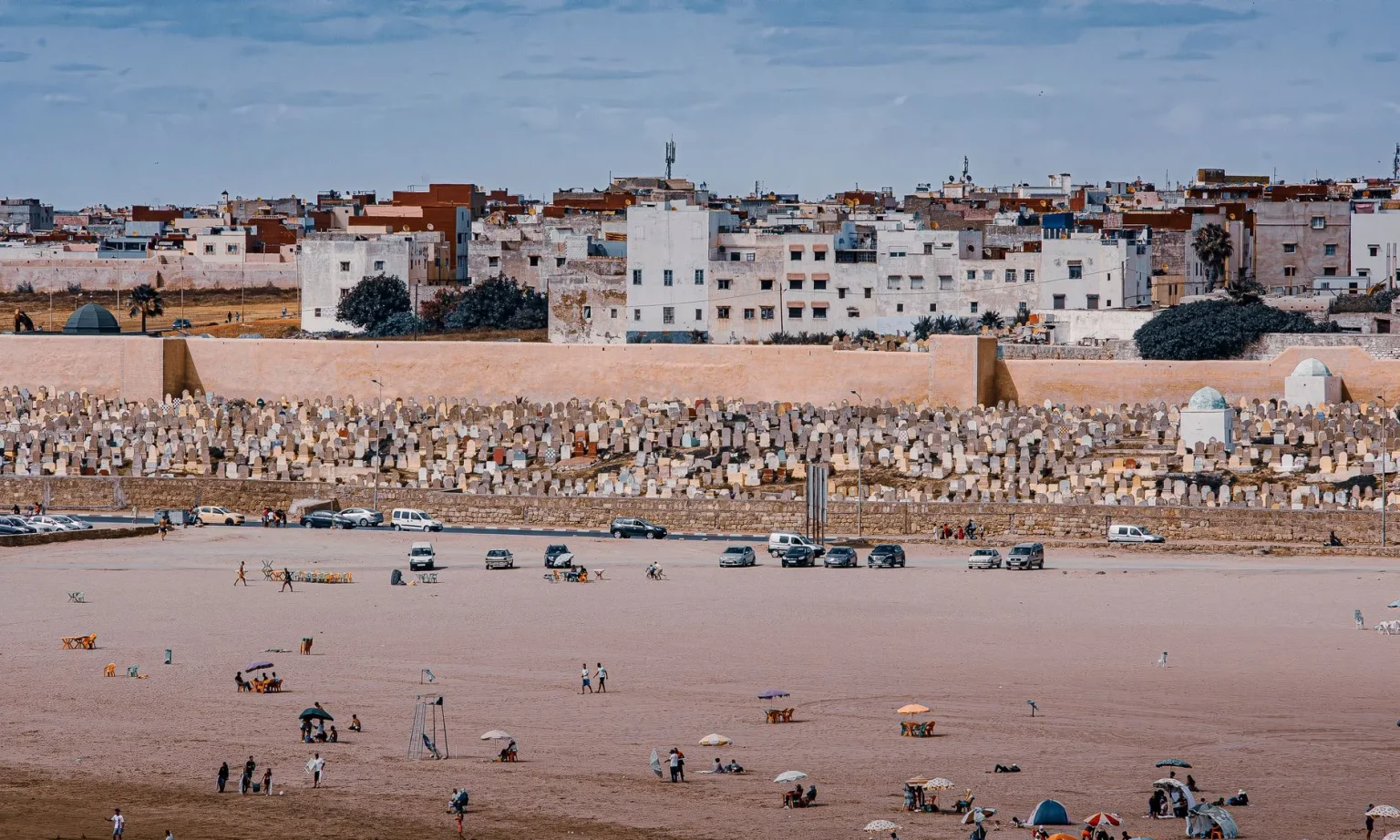

Morocco has coastline on two seas, and they behave nothing like each other.
The Atlantic runs the length of the country and is fed by the Canary current, which comes down cold from the north. It produces world-class surf, reliable wind and water that will take your breath away in June. The Mediterranean coast in the north is shorter, warmer, calmer and far less visited by foreigners — it is where Moroccan families go in August.
Choose the wrong one and you will spend a week looking at a beautiful sea you do not want to get into. Here is how the coast divides.
The Atlantic south: surf and space
Taghazout
A fishing village 19 km north of Agadir that became, over about two decades, the surf capital of North Africa. The right-hand point breaks here are the reason: Anchor Point, Killer Point, La Source. The season runs roughly October to April, when the North Atlantic swells arrive.
Taghazout has changed enormously and not everyone likes the direction. There are surf camps, yoga retreats, flat whites and a large development at Taghazout Bay. The waves are unaffected.
Beginners should go to the beach breaks at Tamraght or Banana Beach just south, not to the points. The points are rock-bottomed and crowded, and the locals have priority — which is both etiquette and, in practice, non-negotiable.
Agadir
Ten kilometres of crescent beach, sheltered by the bay, backed by a promenade of hotels. Agadir was destroyed by an earthquake in 1960 and rebuilt as a modern resort city, which is why it has no medina worth the name and why it feels unlike anywhere else in Morocco.
Judge it for what it is. The bay faces southwest, which makes it one of the few Moroccan beaches with genuinely gentle water, the sand is clean, and it gets around 300 days of sunshine. It is the country’s most reliable family beach and the easiest to reach — Al Massira airport takes direct flights from across Europe.
What it is not is a Moroccan experience. Come for the sun and take a day trip inland.
Legzira
South of Sidi Ifni, red sandstone cliffs meeting a wide empty beach, with natural rock arches carved out by the Atlantic.
Be clear about what is there now: one of the two famous arches collapsed in September 2016. Photographs still circulating online show both. The remaining arch is standing, the beach at sunset is still one of the most striking places on the Moroccan coast, and the rock is actively eroding — do not walk directly beneath it.
Facilities are minimal. A handful of small guesthouses and cafés. That is the appeal.
Dakhla
Far south, on a narrow peninsula enclosing a 40 km lagoon. Flat water inside, ocean swell outside, and wind almost every day of the year.
This is one of the best kitesurfing locations anywhere, and it is now a serious destination — camps along the lagoon, direct flights, a season that effectively never closes. If you do not kitesurf there is less reason to make the journey, though the oyster farms and the desert-meets-ocean landscape reward a few days.
The Atlantic centre: wind and lagoons
Essaouira
A wide sandy bay beneath eighteenth-century ramparts, and wind. Constant, dependable wind — the trade wind the town is built around, which gave Essaouira its nickname as the Windy City of Africa.
This makes it excellent for kitesurfing and windsurfing and mediocre for lying on a towel. The beach is enormous and popular with footballers, camel handlers and quad bikes. Walk south towards Diabat for space.
Essaouira itself is the draw: a compact, walkable, whitewashed medina, a working fishing port where you buy the catch and have it grilled in front of you, and an atmosphere entirely different from the imperial cities. It is the most relaxed place on the Moroccan coast.
Sidi Kaouki
Twenty-five kilometres south of Essaouira. Long, wild, windswept, backed by almost nothing. A few guesthouses, horses on the sand, serious wind. If Essaouira feels busy, this is the answer.
Oualidia
The outlier, and for many the best beach in Morocco.
Oualidia sits on a crescent lagoon between El Jadida and Safi, protected from the Atlantic by a rock barrier with a narrow opening. The result is calm, shallow, warm water on a coast that offers none of that anywhere else — safe for children, still for swimming, and entirely unlike the surf beaches an hour in either direction.
It is also Morocco’s oyster capital. The beds are farmed in the lagoon and the oysters are served at the water’s edge, shucked in front of you. The village is small and the good places book out in summer.
El Jadida and Haouzia
El Jadida has a UNESCO-listed Portuguese cistern, an old fortified town, and a long beach at Haouzia to the north. It is a working Moroccan city rather than a resort, heavily domestic, and priced accordingly.
The north Atlantic: Tangier and Asilah
Asilah
Whitewashed ramparts, blue doors, an annual mural festival that has covered the medina in contemporary art, and Paradise Beach a few kilometres south — reached by track or by boat, broad and clean.
Asilah is quiet out of season and full in August, when Moroccan and Spanish families arrive together.
Around Tangier
The city beaches are unremarkable. Head west along the Atlantic to Achakar, near the Caves of Hercules, where the coast turns to cliffs and small bays. The road out to Cap Spartel — where the Atlantic and the Mediterranean meet — is the drive to do at the end of the day.
The Mediterranean: warm, shallow, undiscovered
This is the coast most foreign visitors never see, and it is where Morocco goes on holiday.
Saidia
Fourteen kilometres of fine pale sand on the Algerian border, known as the Blue Pearl. Shallow, warm, family water. Heavily developed on the resort side and almost empty outside July and August.
Al Hoceima
The best of the Mediterranean coast. A town built around a bay in the Rif, with Quemado beach in the centre and, more interestingly, a national park along the coast holding small coves — Cala Iris among them — reached on foot or by boat.
The water here is clear and genuinely swimmable from June to October. Infrastructure is modest.
M’diq, Martil and Cabo Negro
The strip north of Tetouan, and the busiest Mediterranean stretch — marinas, apartment blocks, promenades, and an enormous domestic summer season. Lively rather than beautiful.
What to know before you swim
- The Atlantic is cold. Water temperatures on the open coast run roughly 16–19°C in winter and 19–22°C in late summer. Surfers wear wetsuits most of the year. The Mediterranean reaches the mid-twenties by August.
- Rip currents are real. Morocco’s Atlantic beaches have strong, consistent rips. Lifeguard cover exists at the main resort beaches in season and essentially nowhere else. If you are pulled out, swim parallel to the shore, not against it.
- Dress. Bikinis and swim shorts are unremarkable at Agadir, Essaouira, Taghazout and the resort strips. On municipal beaches in smaller towns, where families gather, most Moroccan women swim covered. Nobody will confront you; reading the beach you are on costs nothing.
- Wind is the variable nobody plans for. On the Atlantic it typically builds through the afternoon. Mornings are calm. If you want flat water, be on the beach by nine.
- Ramadan changes the rhythm of every coastal town — quiet days, beaches that fill after sunset. The dates shift each year.
Choosing
If you want to surf: Taghazout, October to April.
If you want wind sports: Essaouira in summer, Dakhla all year.
If you want to swim with children: Oualidia first, Agadir second, the Mediterranean in high summer third.
If you want empty: Legzira, Sidi Kaouki, or the coves in Al Hoceima national park.
If you want a town worth staying in rather than a beach with hotels attached: Essaouira, without much competition.
The mistake is to treat the Moroccan coast as one thing. It is two seas and about eight distinct stretches, and the gap between the right one and the wrong one is a week of your life.
